Author: marc

  • Buying a house in the Dordogne: prices, places and where to look

    Buying a house in the Dordogne: prices, places and where to look

    The Dordogne is not the cheap region people expect. It is the most expensive of the affordable regions, and within the département you pay twice as much per square metre in Sarlat as in Nontron. Knowing that difference changes where you look.

    In short

    • On average €1,851 per m² for a house, down 0.8 percent in a year.
    • From €1,186 per m² in Nontron (Périgord Vert) to €2,370 in Sarlat (Périgord Noir).
    • €200,000 buys on average about 108 m² of living space; in Nontron more than 165, in Sarlat around 85.
    • The most searched département on our Dutch sister site’s Search Helper. Typical budget: €170,000 to €300,000, three bedrooms, plenty of land.

    What does a house cost in the Dordogne?

    The département is made up of four Périgords, and they differ more in price than in landscape. The south-east around Sarlat and the Dordogne valley (Périgord Noir) is touristy and expensive. The north around Nontron (Périgord Vert) is green, quiet and a good deal cheaper. Bergerac (Périgord Pourpre) and Périgueux (Périgord Blanc) sit in between.

    sup2;euro;200k buys
    TownPer mHouse, per m²What €200,000 buysHouse, per m²What €200,000 buys
    Sarlat-la-Canéda€2,370± 84 m²
    Périgueux€2,134± 94 m²
    Bergerac€1,908± 105 m²
    Ribérac€1,505± 133 m²
    Nontron€1,186± 169 m²
    The whole Dordogne€1,851± 108 m²

    Averages. Within the département prices range from €766 to €3,432 per m². Source: MeilleursAgents, 1 September 2026, net seller prices.

    On top of the price, allow 7 to 8 percent notaire fees on an existing house (what the notaire does). Whether agency fees are included in the asking price shows in the listing: FAI means included, charge acquéreur means you pay them on top. Work out your own total with the buying costs calculator.

    Where do buyers look?

    On our Dutch sister site, eenhuiskopeninfrankrijk.nl, more people filled in the Search Helper for the Dordogne than for any other département in September 2026. A small sample, but the pattern is clear:

    • They search everywhere, not just the famous south. Sarlat, Daglan and Limeuil in the Périgord Noir, but just as much La Coquille and Nontron in the north, Bergerac and Lacropte in the middle.
    • Budgets are higher than elsewhere. Mostly between €170,000 and €300,000.
    • Land matters. Half asked for at least 1,000 m²; a pool came up regularly.

    What to watch out for

    British buyers have been coming to the Dordogne for fifty years. You won’t discover anything new here; you compete. That has an upside: agents are used to foreign buyers and there is a network of English-speaking builders and services. The downside is the price of exactly the houses everyone wants: a restored stone farmhouse with a pool and a view in the Périgord Noir.

    • Pool and 5,000 m² for under €200,000? It exists, but rarely in the south. Look in the Périgord Vert or around Ribérac, or drop one of the two wishes.
    • Your own drainage. Outside the villages almost every house has a fosse septique. The survey pack includes an inspection by the SPANC; if it says the system doesn’t comply, you have to fix it within a year of buying. Allow a few thousand to over ten thousand euros.
    • Termites. Large parts of the south-west are covered by a termite order. If your commune is in such a zone, the survey pack includes a termite report. Read it properly.
    • Tourism cuts both ways. Sarlat and the valley are full in July and August. Good if you want to let, less good if you are after peace and quiet in August yourself. Go and look once out of season too.
    • Getting there. Bergerac airport has flights to several UK airports, mostly seasonal, and Brive is just over the border of the département. By car it is a long day’s drive from the Channel ports.

    Search the Dordogne straight away

    There is no Rightmove in France: listings are spread over six sites. The Search Helper builds the right searches for all of them in one go. Choose a starting point:

    Town, radius and budget are already filled in. Adjust them, enter your email address and you get the links for Leboncoin, SeLoger, Bien’ici, Green-Acres, PAP and the notaires. How does it work?

    Questions people ask

    Is the Dordogne expensive?

    Not for France: on average €1,851 per m² for a house, against €2,963 in the Pyrénées-Orientales. But among the affordable rural regions, the Dordogne is at the top end, especially in the Périgord Noir.

    Where is a house in the Dordogne cheapest?

    In the north, the Périgord Vert. Nontron is at €1,186 per m², Ribérac at €1,505. The landscape is greener and quieter, and further from the tourist sights.

    Are prices falling?

    Slightly. Houses in the département became 0.8 percent cheaper in a year. Across France, rural houses are falling faster than flats, so there is room to negotiate, especially on houses that have been for sale for a while. The best houses don’t get cheaper because you like them; they do after a winter on the market.

    The buying guide, free in your inbox

    Costs, notaire, compromis, survey pack and the mistakes we and others made. In plain English.

    We email you the guide. Unsubscribe at any time.

    Prices: MeilleursAgents, 1 September 2026, net seller (without agency and notaire fees). Search behaviour: Search Helper sign-ups on eenhuiskopeninfrankrijk.nl, 13 to 23 September 2026, counted per person, anonymous. Updated: October 2026.

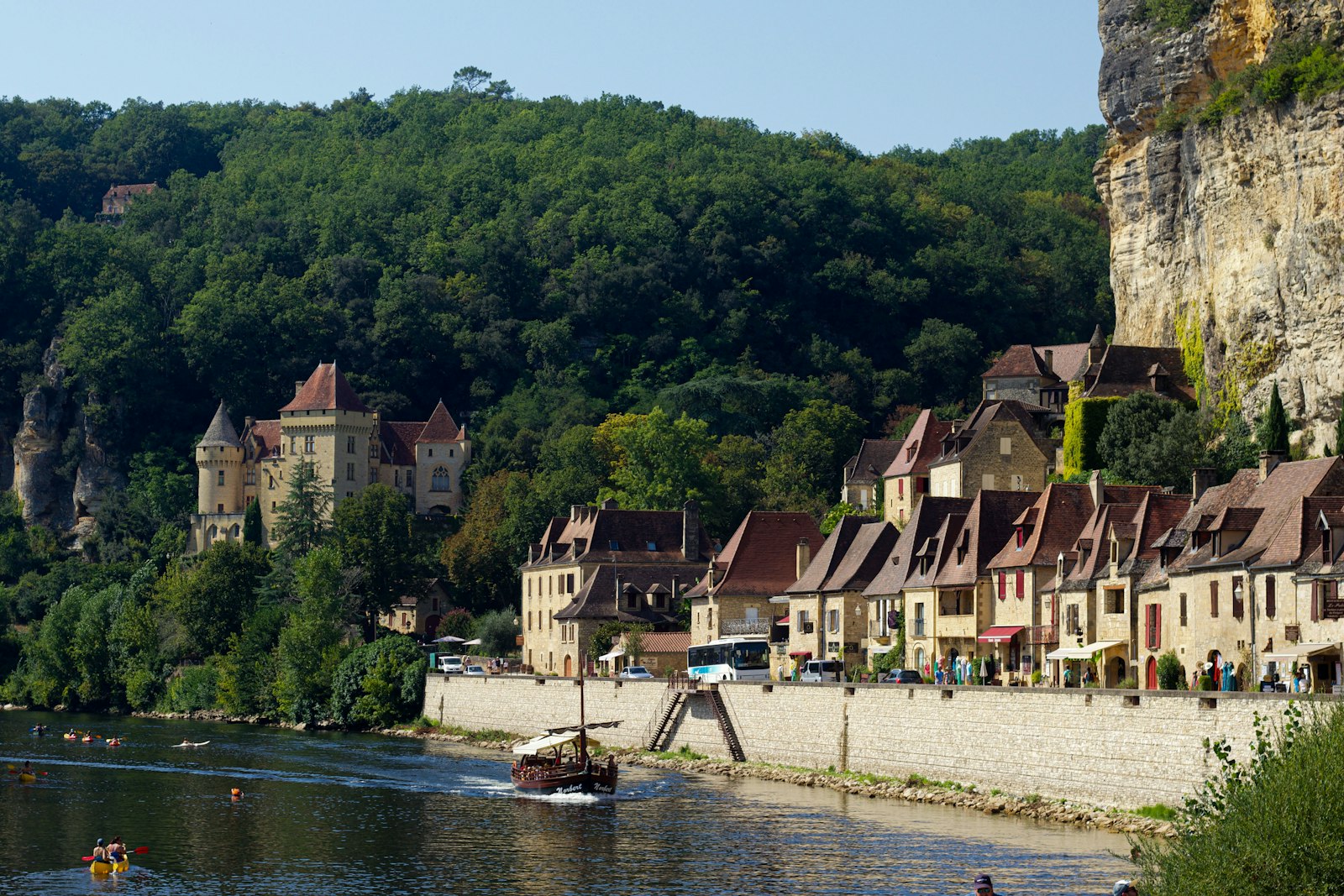
    Photo: Paola Capelletto on Unsplash
  • How to plan a viewing trip in France

    How to plan a viewing trip in France

    In November 2023 my wife Marieke and I saw twelve houses in the Pyrénées-Orientales in four days. I had planned the whole week in Notion: a table of appointments, a page of estate agents to drop in on, and a packing list. It all worked. On paper.

    A viewing trip rarely fails because of the houses. It fails in the diary. Here is how to plan one, what we learned from our own, and how to do it now without Notion: with My trip, the new tab in your shortlist.

    What our own plan looked like

    We ended up buying in Sainte-Marie-la-Mer (the story is in Buying in the Pyrénées-Orientales: what we learned). This was the week behind it:

    • Monday: no houses. Two phone calls to estate agents to confirm the viewings.
    • Tuesday: three viewings, including one in Torreilles on the coast at half past one and one in Céret, inland, at quarter to four.
    • Wednesday: three viewings, spread over the morning and afternoon.
    • Thursday: three viewings, in Sainte-Marie-la-Mer, Le Barcarès and Cabestany.
    • In between: dropping in on estate agents unannounced. That is where we saw what was really for sale, not just what was online.
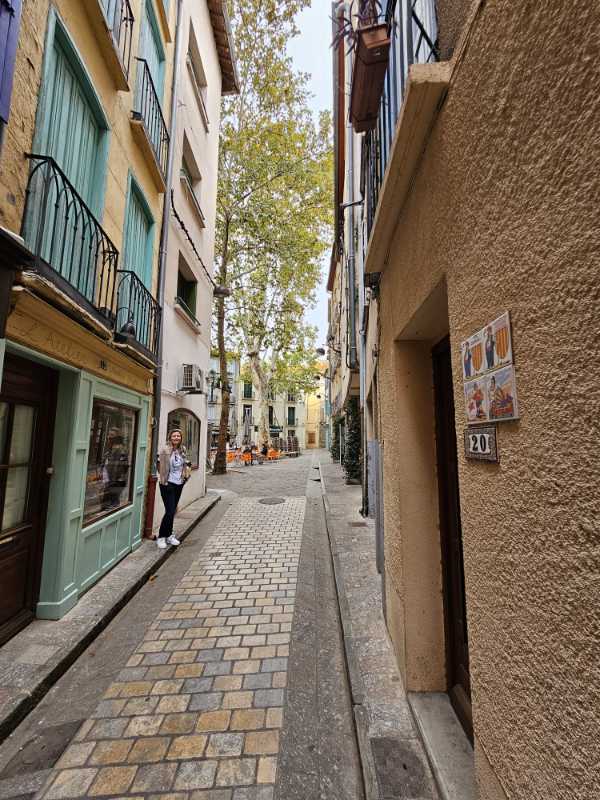
    The old town of Céret with tall stone houses
    Céret, inland. We squeezed it in after a coastal viewing.

    Look at that Tuesday. Torreilles to Céret is roughly three quarters of an hour by car. That works, as long as nothing overruns. But something always overruns at a viewing: the seller wants to show you the garden, the agent knows the neighbour, you want one more look in the loft.

    Five rules for a viewing trip

    • One area per day. The coast one day, inland the next. It saves hours in the car, and you compare houses in the same surroundings.
    • Three viewings a day at most. You will not remember more. After the fourth house the kitchens start to blur.
    • Start with phone calls, not viewings. Confirm every appointment on your first day. An unconfirmed viewing is a wish.
    • Keep a day free. Use it for local estate agents. A local agent often knows about houses before they go online. Read how French estate agents work before you go.
    • Ask for the address in good time. Many listings only name the commune, and you usually only get the exact address from the agent. Ask for it when you confirm.

    How to plan it in My trip

    Your shortlist already had a board and a table. The third tab is now called My trip. This is how it works:

    1. Put your houses on your shortlist. Through the Search Helper, or by pasting the text of a listing.
    2. Set a house to Viewing booked and fill in the date, time and address.
    3. Enter your arrival and departure dates. You then see every day of your trip, including the days with nothing planned yet.
    4. Add your other appointments: an estate agent, the notaire, the bank or a phone call. They slot in between your viewings, in order of time.
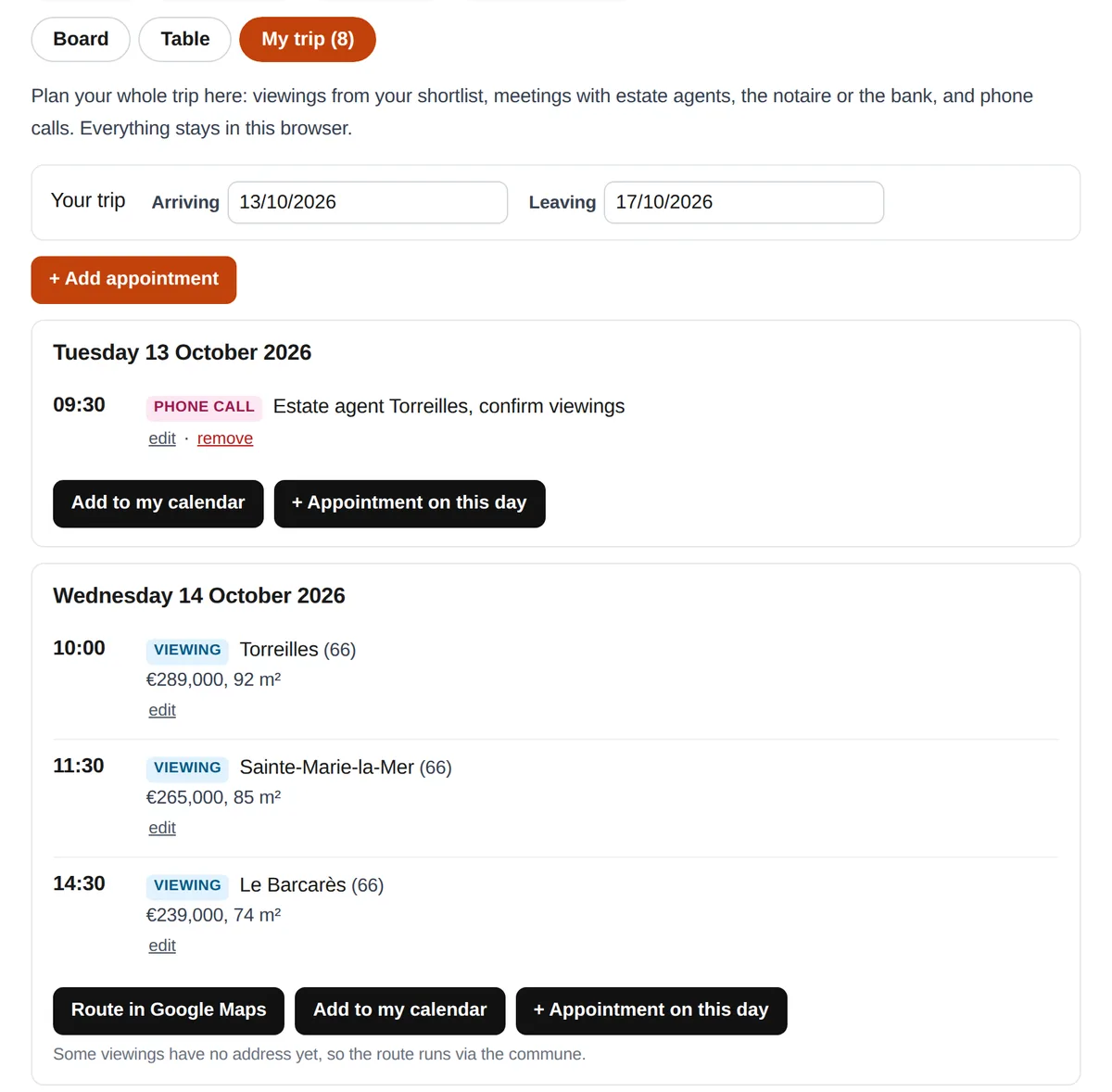
    The My trip tab with arrival and departure dates, a phone call on the first day and three coastal viewings on the second
    An example trip in My trip: phone calls on day one, then three coastal houses on one day.

    Each day has three buttons:

    • Route in Google Maps puts that day’s appointments in order. If an address is missing, the route runs via the commune, and it tells you so.
    • Add to my calendar creates a calendar file for your phone or Outlook. Per day, or all at once with Whole trip in my calendar.
    • + Appointment on this day for anything that comes up later.
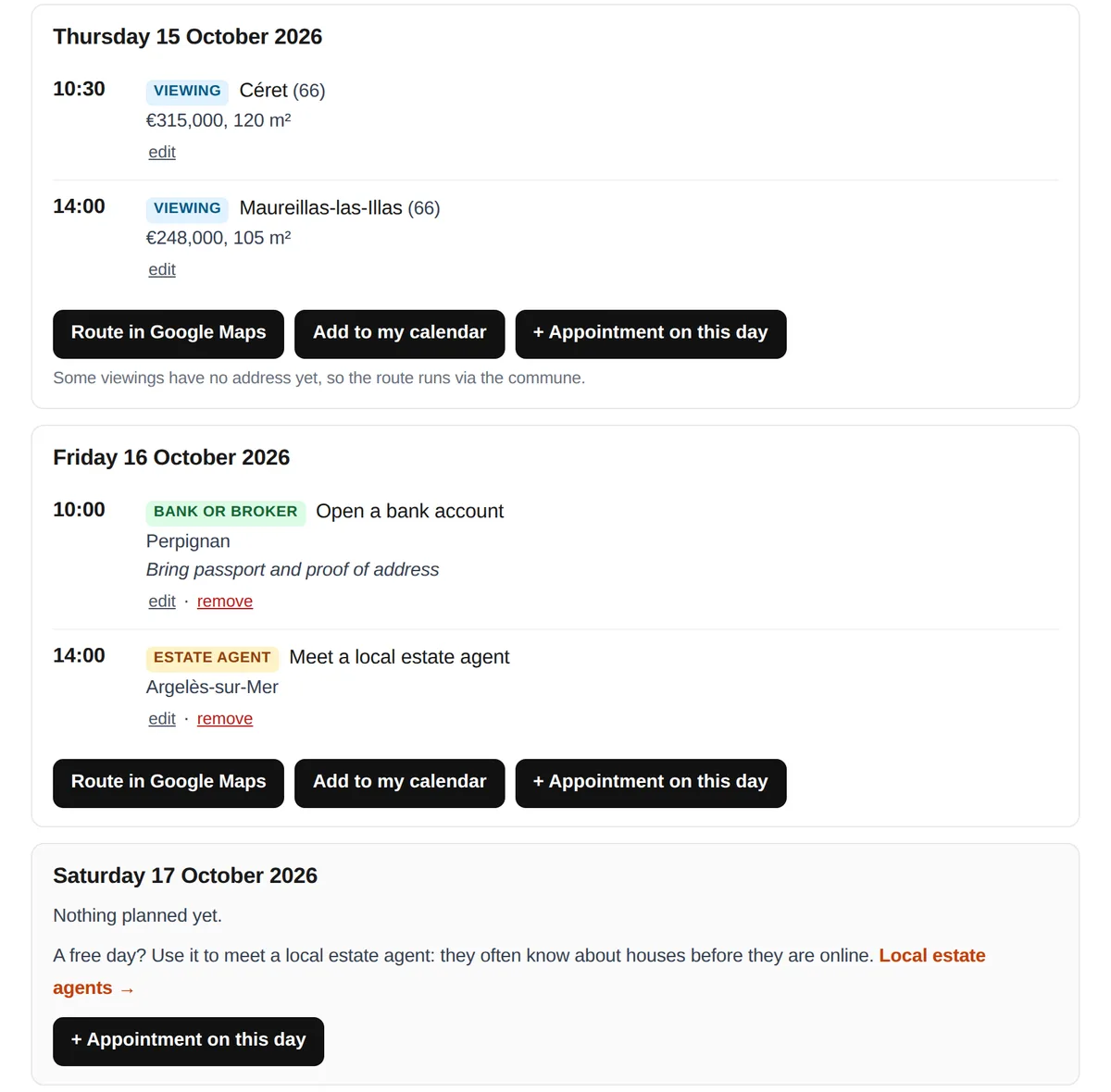
    Two days with inland viewings and appointments at the bank and an estate agent, and a free day with a suggestion to meet a local agent
    A day with nothing planned? My trip suggests meeting a local estate agent.

    The packing list

    Our own packing list from 2023 was mostly chargers. The one in My trip is about the viewings:

    • Documents: your passport and proof of funds or a mortgage agreement in principle. An agent will sometimes ask for it before opening the door.
    • For the viewings: the printed viewing checklist, a tape measure and a torch for the cellar, loft and crawl space.
    • On the road: a Crit’Air sticker if you drive through a low-emission zone.

    Tick off what you have packed and add your own items.

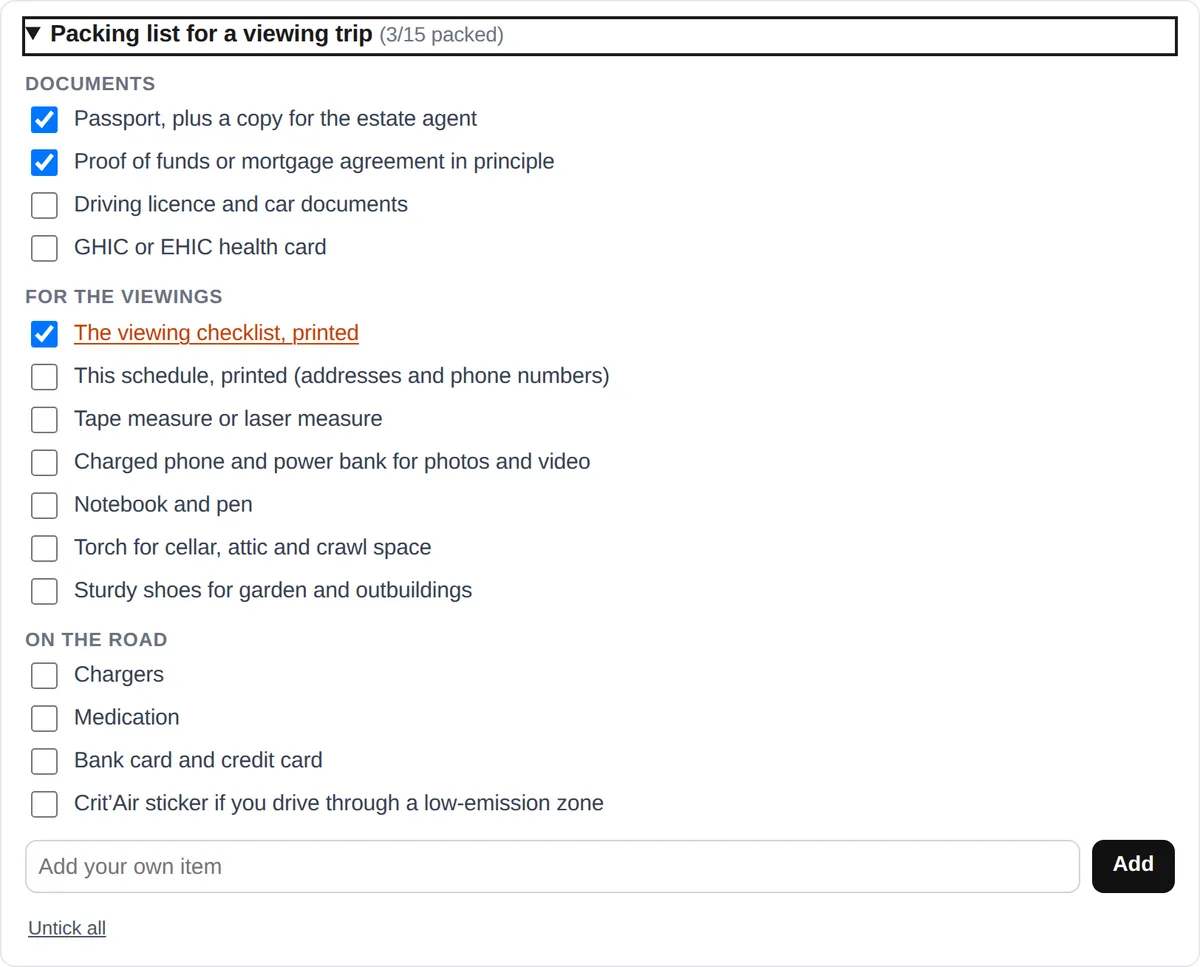
    The packing list in My trip with the groups Documents, For the viewings and On the road
    The packing list in My trip: fifteen standard items, and room for your own.

    Everything stays with you

    My trip works like the rest of the shortlist: everything is stored in your own browser, and we see nothing. Want a backup? Use Email my shortlist to myself below your shortlist, and your houses and viewings are in your inbox too.

    Twelve houses in four days is perfectly doable. Twelve houses in four days across the whole département is not.

  • Buying in the Pyrénées-Orientales: what we learned

    Buying in the Pyrénées-Orientales: what we learned

    We own a house in the Pyrénées-Orientales, in Sainte-Marie-la-Mer, and by now I can say it plainly: it suits us well. Better than we dared hope when we bought.

    Even so, this is not the piece where I tell you to come and look here too.

    Look at this first. A house in the Alpes-Maritimes, around Nice and Cannes, costs on average €5,671 per square metre. On the same Mediterranean, a few hundred kilometres west, you pay €2,963 here (MeilleursAgents, 1 September 2026). Almost half. Anyone who sees that gap starts looking for the catch, and there is one. It just isn’t where most buyers look.

    So here is what this area is, what it isn’t, and the two things we only found out once we were already here.

    Why we chose it

    • The climate. Warm summers with a breeze, winters that often stay above ten degrees, and pleasant weather from March to November.
    • Sea and mountains together. The beach in the morning, and ski resorts such as Font-Romeu and Les Angles within about an hour and a half.
    • The Catalan character. Warm, welcoming, and noticeably different from the rest of France.
    • Spain next door. Barcelona and Girona are an easy day out.

    This is Catalonia, and that is not folklore

    • The signs are bilingual. Perpignan is also Perpinyà.
    • The flag on the houses is yellow with red stripes, not blue, white and red.
    • At midsummer, Sant Joan, a flame is brought down from the top of the Canigou, the 2,784-metre mountain that dominates the whole département, and carried to the villages in the valley. That is not an event for tourists. That is a region explaining who it is.
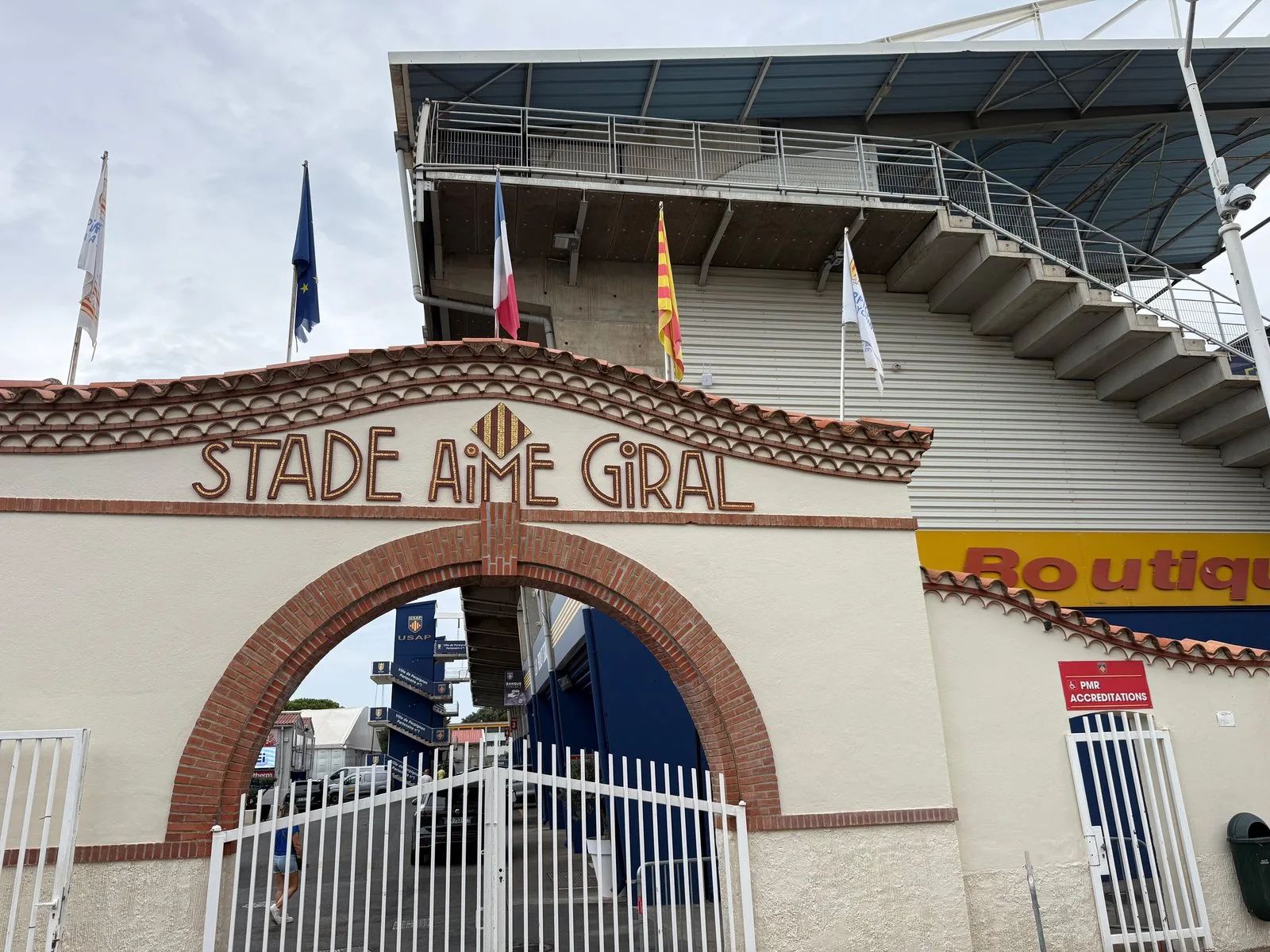
    Stade Aimé Giral in Perpignan, home of the USAP rugby club. The Catalan flag flies next to the French and European ones.
    Stade Aimé Giral in Perpignan, home of the USAP rugby club. The Catalan flag flies next to the French and European ones.

    For you as a buyer that has a practical side. You are not moving to “the south of France” with olive trees, lavender and a Provençal market. You are moving to an area with its own language, its own cooking and its own relationship with Spain, which starts half an hour down the road. If that appeals, you will love it here. If you wanted the Provence postcard, you will be disappointed.

    The coast is really two coasts

    North of Argelès: the sandy coast. Le Barcarès, Sainte-Marie-la-Mer (where we are), Canet-en-Roussillon, Saint-Cyprien and Argelès-sur-Mer itself.

    • Wide beaches, lots of flats and campsites, lots of building from the 1970s and 1980s.
    • Full in August, quiet in January, and that difference is bigger than you can feel at a viewing in May.
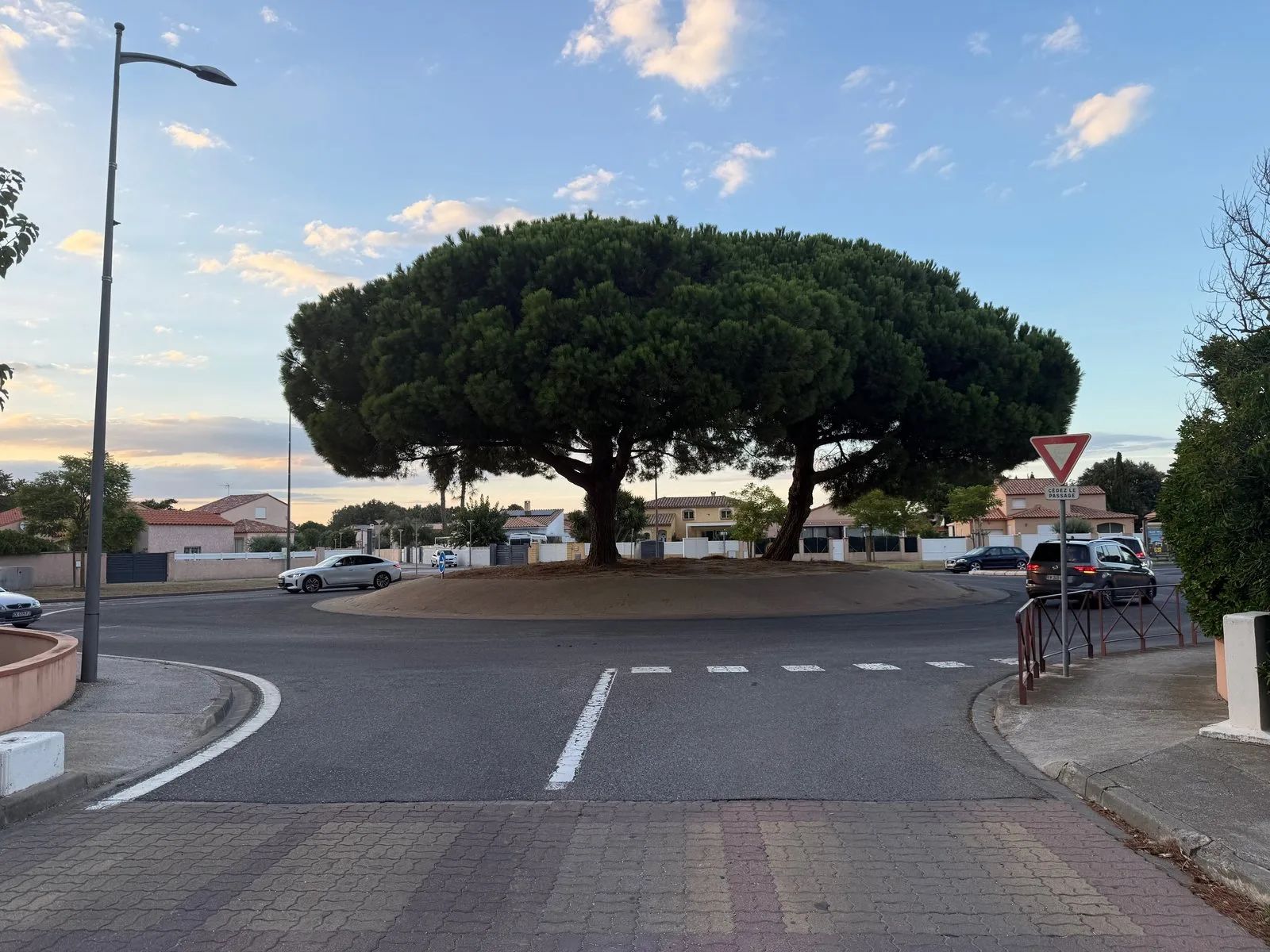
    Sainte-Marie-la-Mer away from the beach. Not a postcard, but exactly what the coastal villages really look like.
    Sainte-Marie-la-Mer away from the beach. Not a postcard, but exactly what the coastal villages really look like.

    South of Argelès: the Côte Vermeille. Here the Pyrenees run into the sea, the coast turns rocky and the villages sit in bays.

    • Collioure, where Matisse and Derain invented Fauvism in 1905 because the light did something there it did nowhere else.
    • Port-Vendres, still a working harbour.
    • Banyuls-sur-Mer, of the sweet wine and the sculptor Aristide Maillol.
    • Cerbère, the last village before the border, which grew because French and Spanish trains ran on different gauges and everything had to be transferred there.

    That second coast is prettier, more expensive and thin on houses for sale. Collioure sells itself. Don’t count on département averages there.

    Perpignan is a real city, with everything that comes with it

    Plenty of buyers want to be “near Perpignan” without ever having spent a week there. Do spend one.

    • The good: a hospital, schools, a university, a TGV station, daily markets and an old centre with the Castillet and the Palace of the Kings of Majorca. Life, twelve months a year. Exactly what a coastal village doesn’t give you in January.
    • The less good: it is also a city with poverty, with neighbourhoods where you shouldn’t buy blind, and with unemployment among the highest in France. That is part of the reason you pay half of what Cannes costs.

    Walk the street where you want to buy three times at three different moments, and make sure one of them is a Sunday evening in November.

    Lesson one: the tramontane

    The tramontane is a dry, strong north-westerly wind squeezed through the gap between the Pyrenees and the Corbières towards the sea.

    • The upside: it clears the air, keeps humidity low and keeps the mosquitoes away.
    • The downside: it wrecks your parasol, your awning and your terrace plants, and after three days it starts to wear on your mood.

    This is not a reason not to buy. It is a reason to ask at a viewing which side the house catches the wind from, and whether that lovely terrace is sheltered or exactly in the firing line. At our viewing we looked at the view. We didn’t look at the wind direction.

    Lesson two: water, and this is the real catch

    The Pyrénées-Orientales has been in drought since 2022, and it has not been one bad summer.

    • In summer 2026 the Aspres area, 23 communes, was again at the highest level, “crise”, under the prefecture’s July order, with other zones on alert. The latest order dates from 11 September 2026.
    • In practice that means, depending on the level: no filling private pools, watering restricted to certain hours or banned, limited car washing. Fines run to €1,500.
    • That hits exactly the things a second home is bought for.

    So this is the question you ask, at the mairie and not the agent, before you make an offer: which zone is this commune in, what restrictions apply now, and what applied in the last three summers? You can also look up any commune on vigieau.gouv.fr, and the prefecture publishes every order online.

    Getting here from the UK and Ireland

    • Perpignan airport: seasonal Ryanair flights from London Stansted, Birmingham and Leeds Bradford, and Aer Lingus from Dublin. Jet2 has announced Manchester from May 2027.
    • Girona and Barcelona: far more routes, many all year, then a drive across the border.
    • Carcassonne and Béziers: more seasonal Ryanair flights, a bit over an hour’s drive away.
    • By train: Eurostar to Paris, then a direct TGV to Perpignan in about five hours at best.
    • By car: a long two-day drive from the Channel ports.

    Flight schedules change every season, and several French regional routes were cut in winter after France raised its air ticket tax in 2025. Work it out honestly once, including how often a year you want to come. That sum changes more decisions than whether the house is pretty.

    Who this area works for

    • For people who want the sea, are happy to have the mountains too, don’t mind Spain round the corner and aren’t expecting a Provençal village.
    • For people who want their budget to buy square metres rather than a postcode.
    • For people willing to ask the water question before it gets fun, rather than finding out in July that the pool stays empty this year.
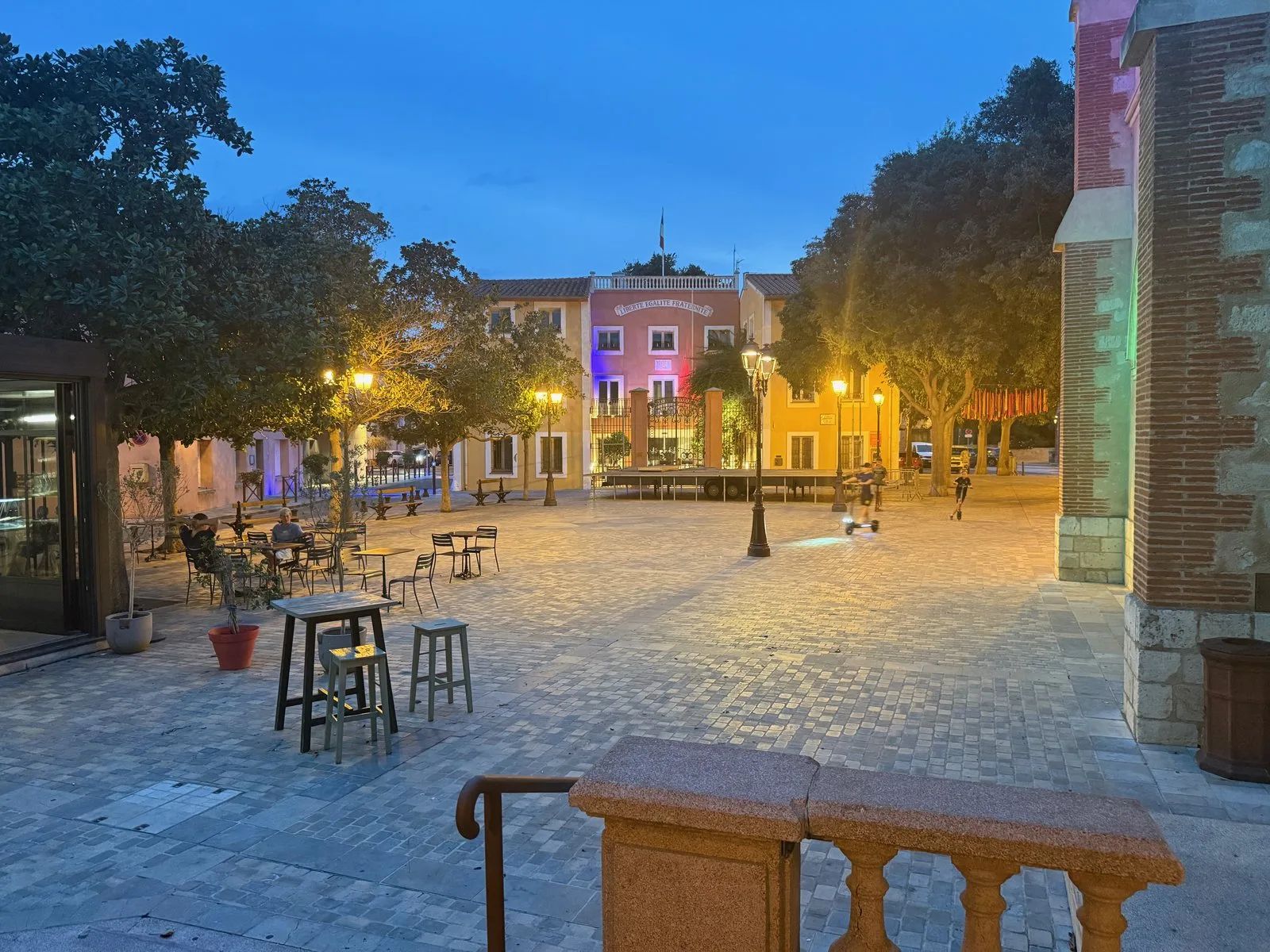
    The village square of Sainte-Marie-la-Mer in the evening, with the town hall lit up.
    The village square of Sainte-Marie-la-Mer in the evening, with the town hall lit up.

    We bought here and would do it again. But not because it was cheap. The area costs half as much as the Côte d’Azur, and that is not a bargain. It is a price with a story, and you can find out that story before you sign.

    Not sure yet whether this is your region? Try the region finder: eight questions, three regions that suit you. Going to viewings? Take the viewing checklist, and use the buying costs calculator to work out what a house really costs, including the notaire.

    Prices: MeilleursAgents, 1 September 2026. Drought measures: Préfecture des Pyrénées-Orientales, orders of July and 11 September 2026. Flights: airport and airline announcements, summer 2026. Background on the Côte Vermeille and Catalan Roussillon partly inspired by Détours en France no. 274, September 2026.

  • New: the Search Helper. Fill in once, search six French property sites.

    New: the Search Helper. Fill in once, search six French property sites.

    When I wrote that there is no French Rightmove, and how to build your own, one reply came back more than any other: “Great, but I can’t do it. I just don’t understand those French sites.”

    Now there is something for that. The Search Helper is made for everyone who can’t get on with French property sites: no French, no filters, no département codes. You fill in once what you are looking for, and we set it up on six French property sites. All you do is click.

    Go to the Search Helper

    Why searching French sites so often goes wrong

    When Marieke and I were looking in the Pyrénées-Orientales, we spent the first six months doing it exactly wrong. These are the mistakes almost everyone makes:

    • You enter a département and get thousands of houses, from the coast to deep in the mountains. After ten minutes of scrolling you give up.
    • You only search the town you know. French buyers search with a radius of twenty or thirty kilometres and also see the villages whose names you don’t know yet.
    • You don’t understand the French buttons. “Sauvegarder la recherche”, “Créer une alerte”, “chambres” versus “pièces”: every site does it differently.
    • You don’t set an alert. In a popular commune a keenly priced house is gone within a week. Without an alert you see it too late.

    The difference is bigger than you think. Search SeLoger for Céret alone and you get 122 houses. Add everything within twenty kilometres and there are 1,364. On Leboncoin more than 2,500. Same budget, same wishes. You just weren’t seeing them.

    How the Search Helper works, in four steps

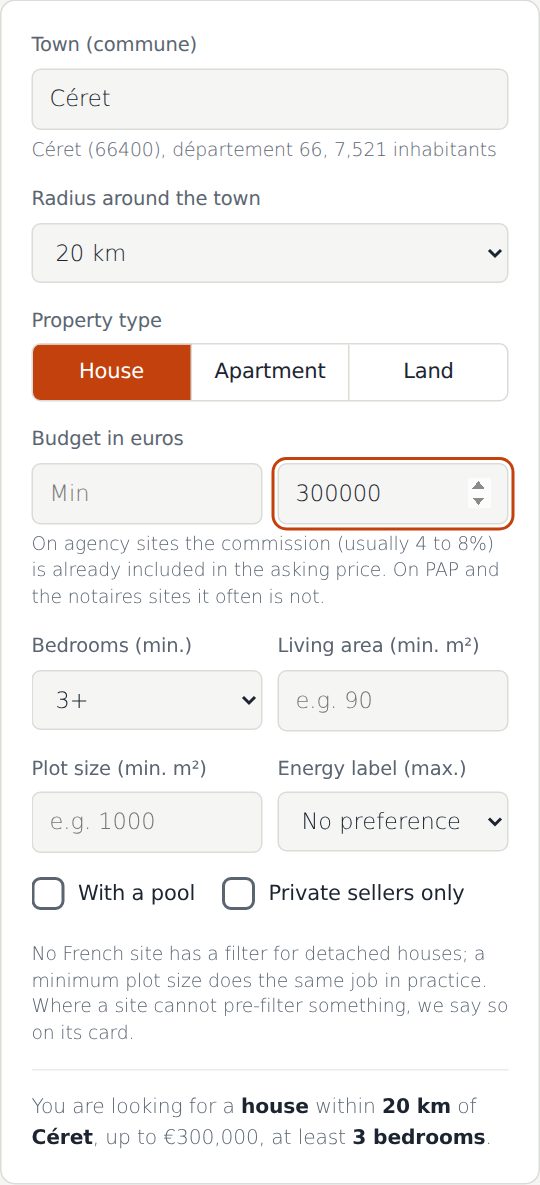
    Step 1: fill in once what you are looking for. In English. A town, a radius, house or flat, your budget and the number of bedrooms. If you want, add a minimum plot size, a maximum energy rating, a pool or private sellers only.

    One form, in English. The Search Helper works out which villages fall within your radius.
    One form, in English. The Search Helper works out which villages fall within your radius.

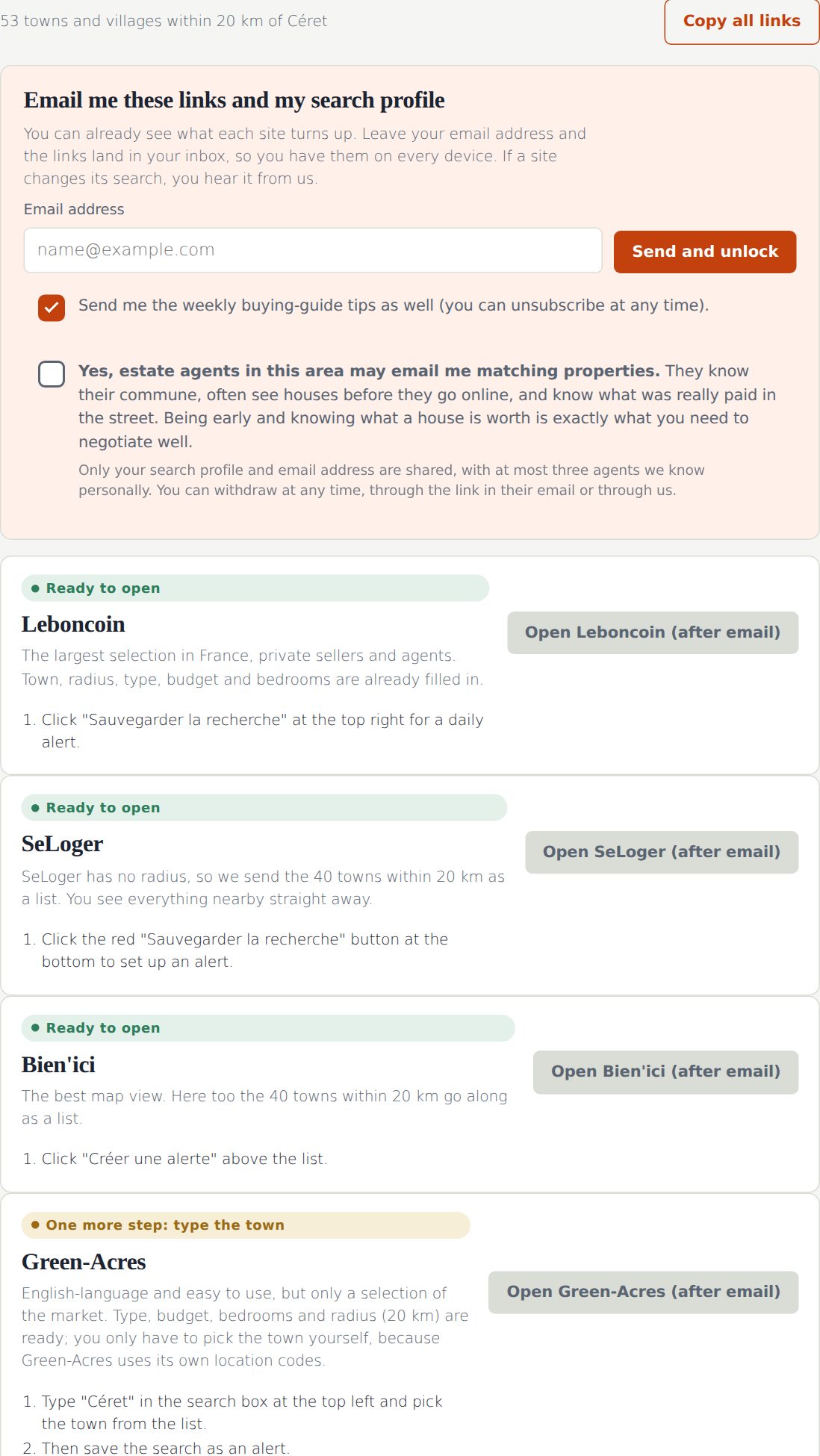
    Step 2: open the sites with one click. Each site gets its own card.

    • Leboncoin, SeLoger and Bien’ici: fully prefilled, including the villages within your radius. You click and land on the results page with your search.
    • Green-Acres: opens in English with type, budget and radius ready; you only type in the town.
    • PAP and the notaires: they can’t be prefilled, so you get a crib sheet: fill in this, in this order.
    One button per site, plus instructions in English for setting the alert.
    One button per site, plus instructions in English for setting the alert.

    Step 3: set an alert there. Each card tells you, in English, which button to click. From then on new listings come to you instead of the other way round.

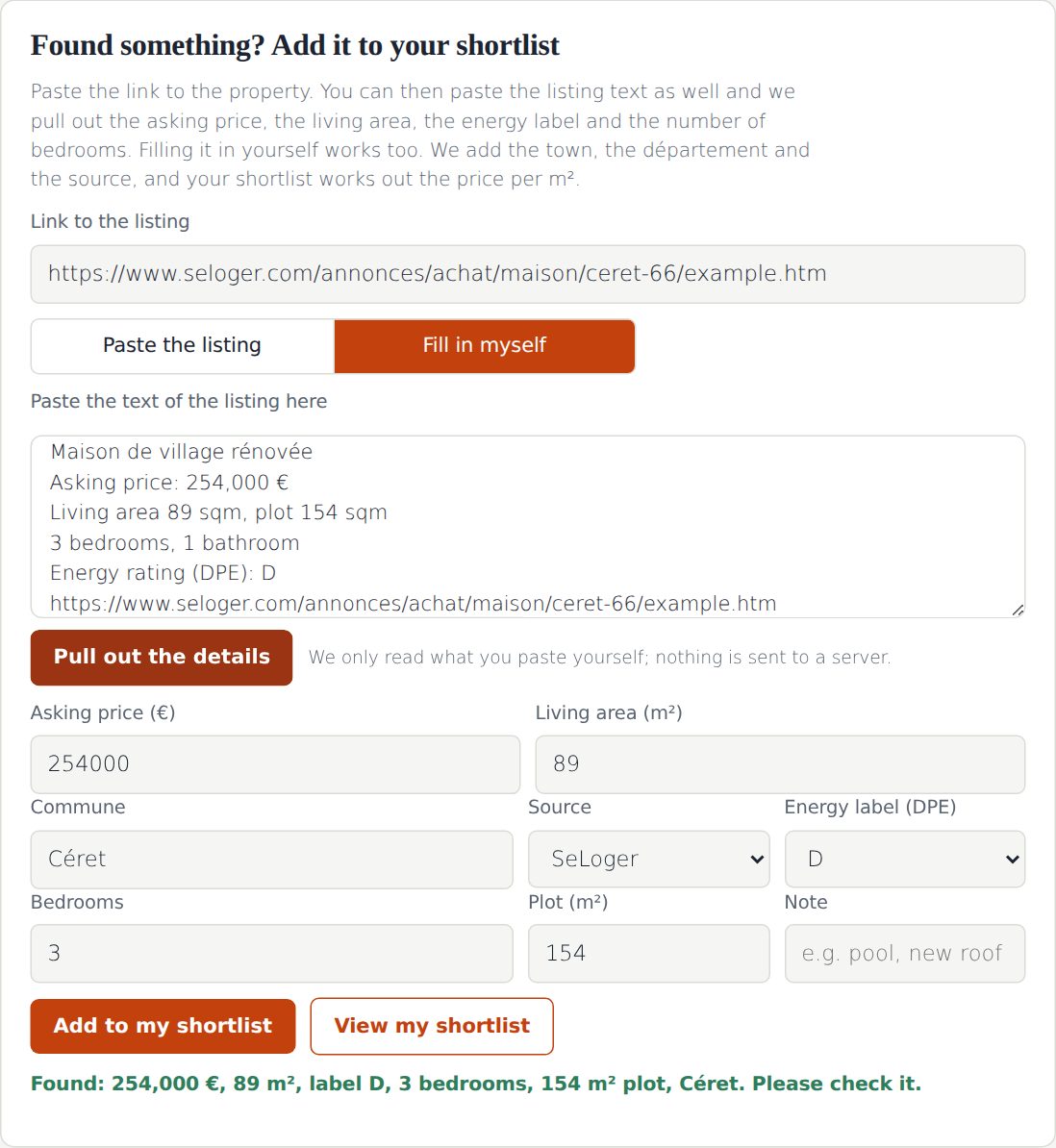
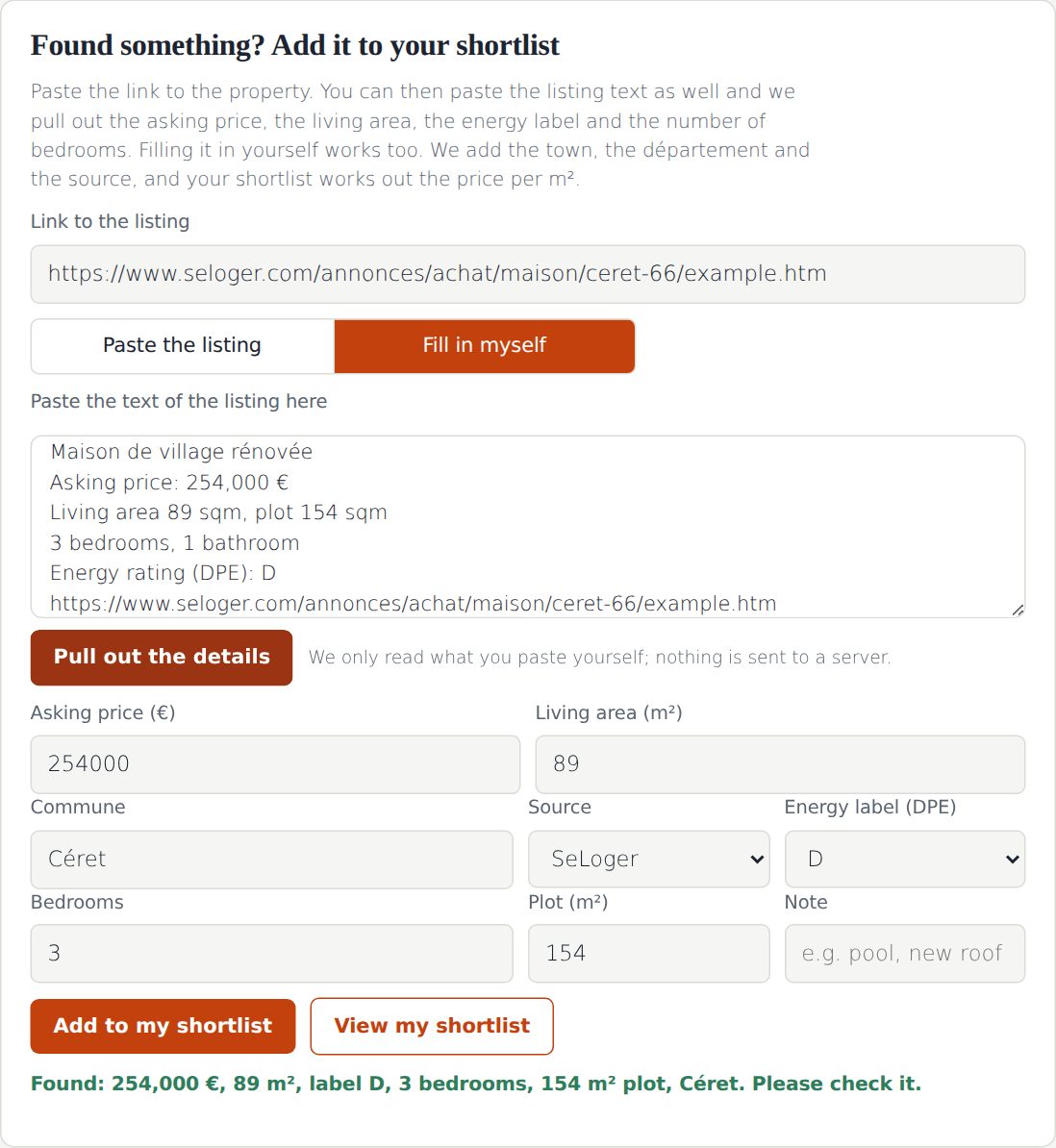
    Step 4: keep what you find on your shortlist. At the bottom of the Search Helper you paste the link of the house. Paste the text of the listing as well, and the tool picks out the asking price, living area, energy rating and number of bedrooms. Town, département and source are filled in for you. Your Shortlist works out the price per square metre.

    Found something? Paste it and it goes on your shortlist, with the price per m².
    Found something? Paste it and it goes on your shortlist, with the price per m².

    After three weeks that list shows you things no single site does: which houses stay unsold, where prices drop, and what a realistic price per square metre is in your commune. And before you make an offer, check DVF, the public database of what was really paid in that street over the past five years. An asking price is an opinion. DVF is a fact.

    Your links in your inbox

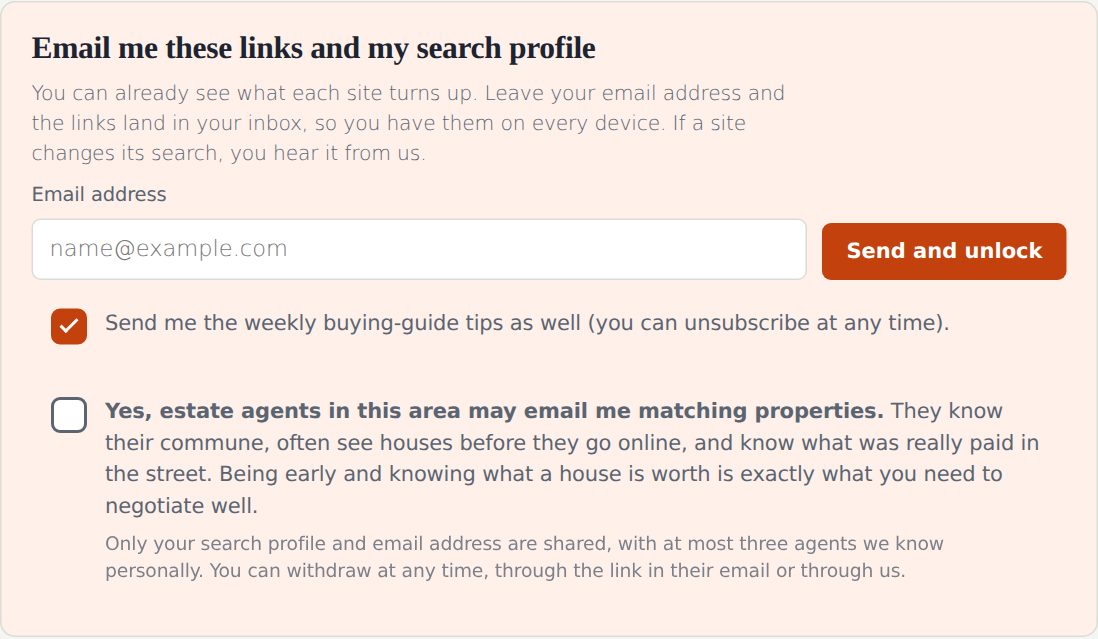
    Leave your email address and your links arrive in your inbox. That way you find them again on your phone and laptop, without filling everything in again.

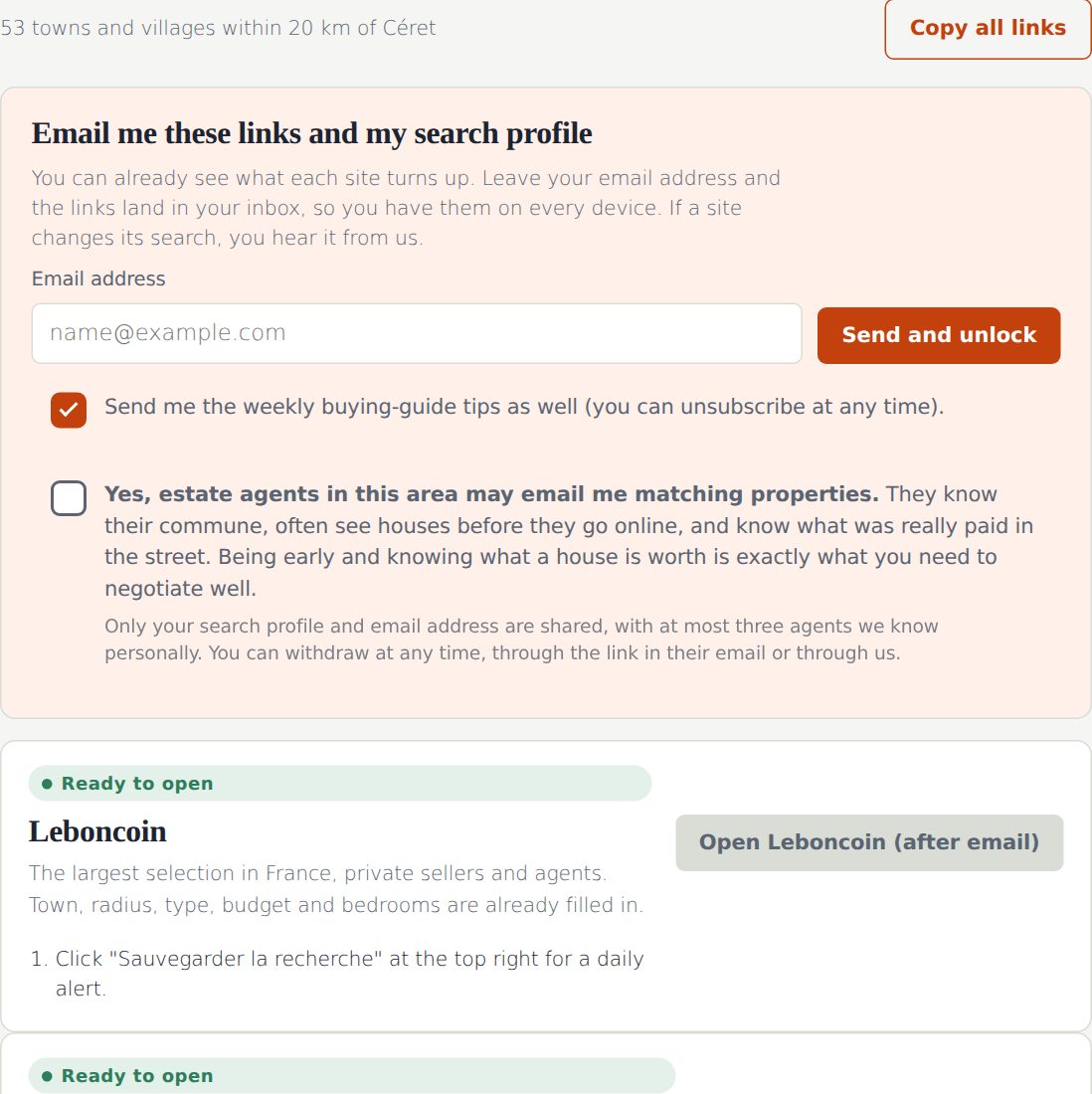
    Enter your email address and your search profile with all the links lands in your inbox.
    Enter your email address and your search profile with all the links lands in your inbox.
    • If a site changes its search function, we let you know and update the links.
    • There is a separate box for anyone who wants a local estate agent to email suitable houses. It is unticked by default, it goes to agents we know (in the Pyrénées-Orientales that is our partner Liam Gall), they only receive your search profile and email address, and you can withdraw at any time.
    • Leave the box empty and nothing changes.

    Who is it for?

    • Anyone who has ever given up on a French property site.
    • Anyone who doesn’t speak French and doesn’t want to guess what “pièces” means.
    • Anyone who knows an area but not the names of the thirty villages around it.
    • Anyone who simply wants to see what is for sale, without first taking a course in French property websites.

    The Search Helper is free, like the rest of the site. Enter your town and see what is for sale within twenty kilometres. Chances are it is more than you thought.

    Go to the Search Helper

    Something not working, or a site missing? Let us know through the contact form. The tool is new and we improve it with your feedback.

  • There is no French Rightmove. Here is how to build your own.

    There is no French Rightmove. Here is how to build your own.

    The first thing I did when we started looking seriously in the Pyrénées-Orientales was search for the French Rightmove. I spent a whole evening on it. That site does not exist.

    That is not a gap in the market someone is about to fill. It is simply how the French property market works. And once you understand that, you search better than most buyers who will be standing next to you at the same viewing.

    Why the UK has Rightmove and France doesn’t

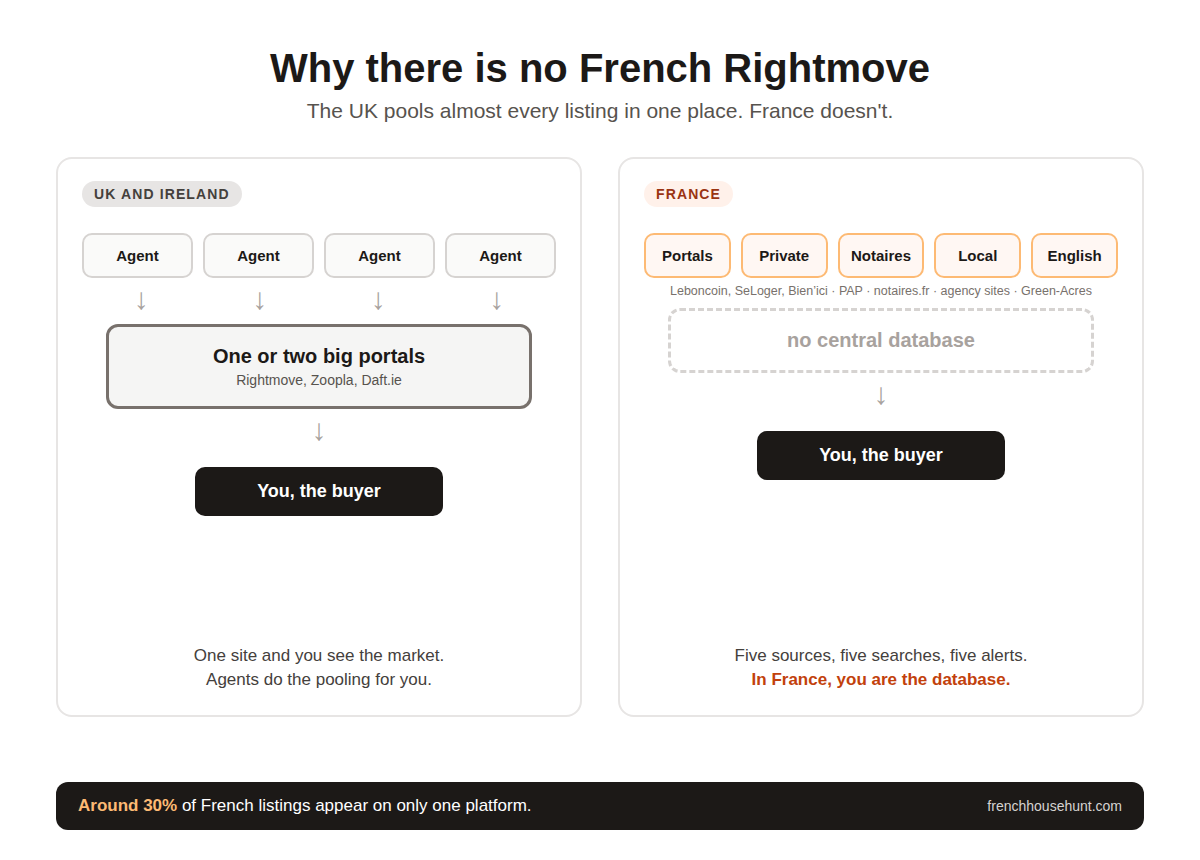
    In the UK almost every agent puts their listings on one or two big portals. In Ireland it is Daft.ie and MyHome.ie. You open one site and you see the market. It feels so normal that you don’t notice how unusual it is.

    France has no such central database:

    • No obligation to list. There is no legal requirement to register a house for sale anywhere, and no trade body that pools the listings.
    • Several agents per house. A seller usually signs a mandat simple with an agent, which lets them give the same house to three other agencies as well. Each agency takes its own photos, writes its own text and charges its own fee. That is why you find the same house on three sites with three different prices.
    • The portals are adverts, not a register. Agents pay per listing. Whoever doesn’t pay isn’t there. By one estimate around 30 percent of listings appear on only one platform.
    • A big share never reaches the portals. Notaires sell houses themselves, private owners sell directly, and in many villages the best house is still in the window of the agency on the square.

    With close to a million sales a year (958,000 in the twelve months to the end of February 2026, according to the Notaires de France), that adds up to a huge number of houses you never see if you stick to one site.

    Why there is no French Rightmove: the UK pools listings in one place, in France you are the database.
    Why there is no French Rightmove: the UK pools listings in one place, in France you are the database.

    The five layers of the French market

    Don’t think in websites, think in layers. Each layer has a different kind of seller, and so a different kind of opportunity.

    1. The big commercial portals.

    • Leboncoin has the most volume: over a million listings and around 42 million visits a month, private sellers and agents mixed.
    • SeLoger is the agents’ stronghold, and has taken private listings too since 2023.
    • Bien’ici is owned by the French estate agents’ federations, so it only carries professional listings, but it has by far the best map view.

    2. Private sellers. PAP.fr stands for de particulier à particulier and only accepts private sellers. No agency fee, so at the same asking price you pay less. Few foreign buyers search here seriously, because it is all in French and the owner answers the phone.

    3. The notaires. immobilier.notaires.fr and immonot.com are the sites of the French notaries. In large parts of the country, especially Normandy, Brittany and the north, the notaire sells houses directly. Those listings often appear nowhere else, and competition from other buyers is lowest.

    4. Local channels. The village agency’s own website, the regional paper, the noticeboard at the bakery. Agents usually put a new house on their own site first and only days later on the portals, if at all. This is the layer where speed lives.

    5. English-language sites. Green-Acres, Properstar and the UK portals for overseas property. Comfortable, because everything is in English and someone picks up the phone. But it is a selection of a selection, often priced with a foreign buyer in mind. Here, comfort costs money.

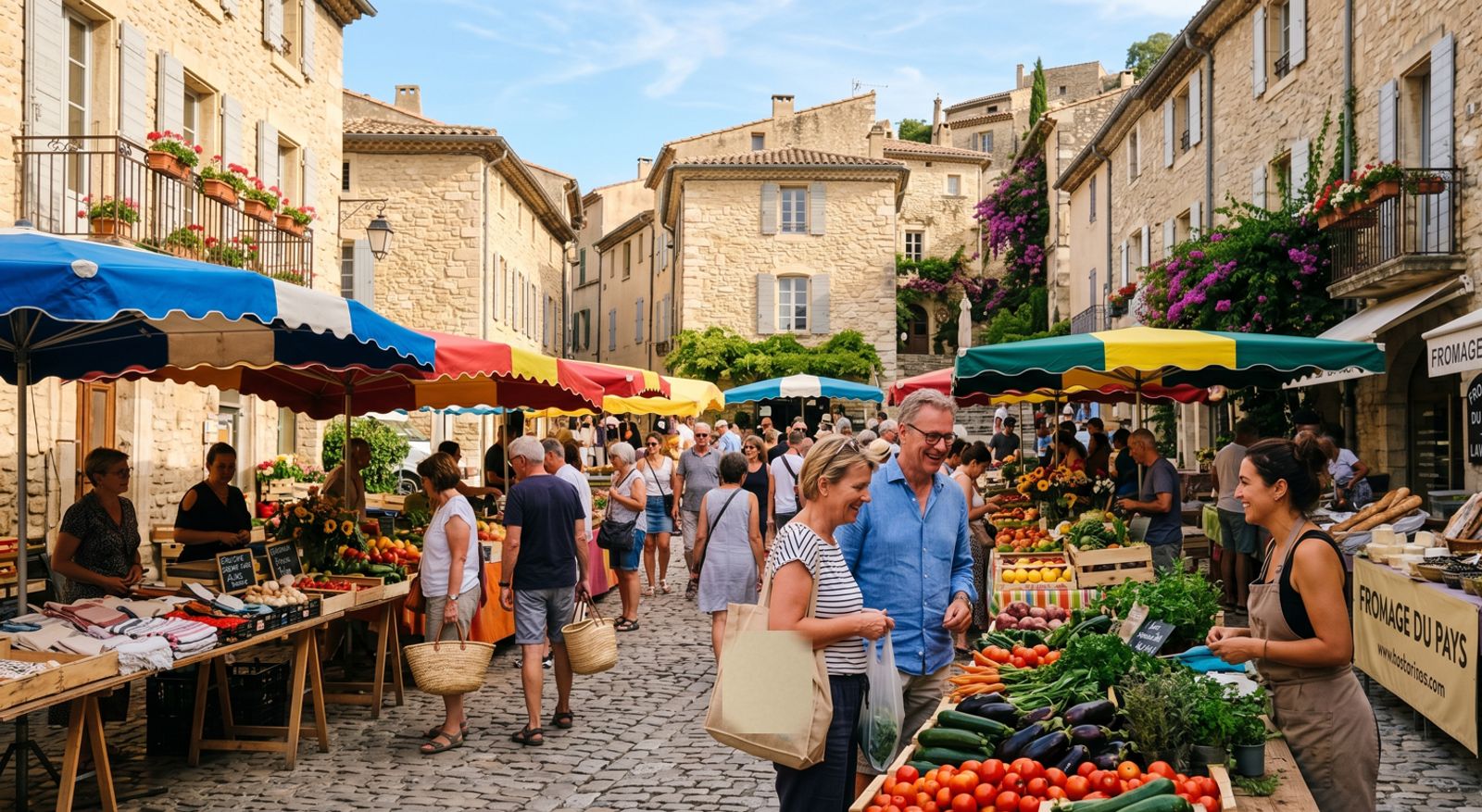
    A French village market
    A French village market

    Your own French Rightmove, in one evening

    The answer is not finding one better website. It is building a system that searches the five layers for you while you get on with your life.

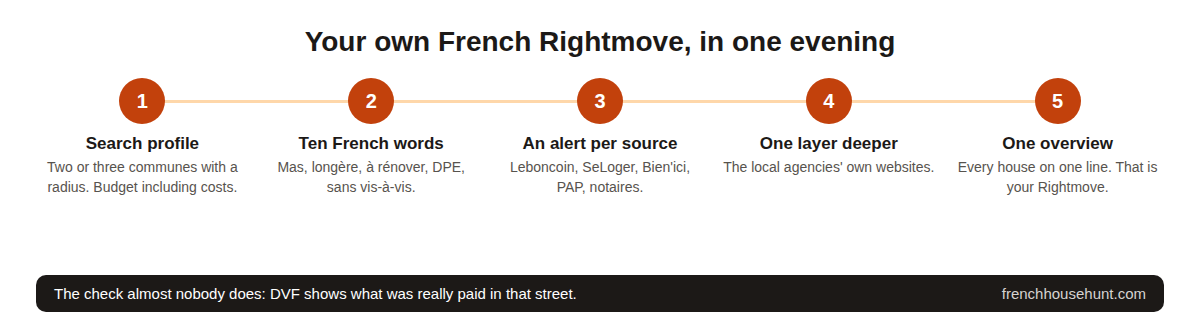
    Your own French Rightmove in one evening: five steps.
    Your own French Rightmove in one evening: five steps.

    Step 1. Fix your search profile before you open a single site.

    • Not “the south of France”, but two or three communes with a radius around them.
    • Not “about two hundred thousand”, but a maximum including notaire fees, agency fees and the first round of work.
    • Not sure where? Try the region finder first and run your numbers in the buying costs calculator.

    Step 2. Learn ten French words. Maison de village, mas, longère, mazet, corps de ferme, terrain constructible, à rénover, viager, DPE, sans vis-à-vis. Without them you search France like a tourist.

    Step 3. Save a search with an alert on every source. This is the heart of it, and the step most people skip.

    • Create an account on Leboncoin, SeLoger, Bien’ici, PAP and immobilier.notaires.fr.
    • Enter your profile, save the search and set the alert to daily or instant.
    • Search by commune with a radius, not by département, or your inbox drowns.

    From then on the market comes to you. In a popular commune a keenly priced house is gone within a week, and the difference between viewing it or not is exactly that alert.

    Step 4. Go one layer deeper than the portals. Search for immobilier plus the town name and open the agencies’ own sites. Bookmark them in a folder and check them every week. Search the same commune on immonot too, because notaire listings rarely reach the portals.

    Step 5. Keep everything in one overview. One line per house, with: link, commune, asking price, agency fee included yes or no, living area, plot, DPE rating, taxe foncière, date found, status and your own note.

    That overview is your Rightmove. After three weeks it shows you things no site does: which houses stay unsold, where prices drop, and what a realistic price per square metre is in your commune. Take your viewing checklist once you start viewing, and you compare like with like.

    Don’t want to build a spreadsheet? The free Shortlist does it for you, with the price per m² worked out. And if the French sites themselves are the problem, the Search Helper sets up steps 1 to 3 on six sites at once.

    The Shortlist: every house from every site in one list.
    The Shortlist: every house from every site in one list.

    The check almost nobody does

    There is one source no agent will mention unprompted, and you can learn it in five minutes: DVF.

    • What it is: demandes de valeurs foncières, the French tax authority’s open database of the prices actually paid in every property sale.
    • How far back: the last five years, down to the individual plot.
    • How current: updated twice a year, in spring and autumn.
    • What’s missing: Alsace, Moselle and Mayotte, where the records are kept elsewhere.

    Click on the street where the house is and you see what the neighbours really paid, when, and for how many square metres. Go there before you make an offer, not after. An asking price is an opinion. DVF is a fact.

    What this gets you

    One evening’s work. Five accounts, five alerts, a bookmark folder of agency sites and the overview from step 5. After that you see more houses than someone who spends an hour on one site every Sunday, and you see them sooner.

    The French Rightmove is not coming. Whoever accepts that first sees the house first.

    One thing worth knowing before you ring the first agency: the agent works for the seller, not for you, and his commission is usually already inside the asking price.


    Sources: listing and visitor figures from Pretto, “Quel est le meilleur site immobilier en 2026”; the 30 percent single-platform estimate and Bien’ici ownership from monmarcheimmobilier.fr (2026); 958,000 sales from the Notaires de France market note of 27 April 2026; DVF details from the app.dvf.etalab.gouv.fr FAQ.