The first thing I did when we started looking seriously in the Pyrénées-Orientales was search for the French Rightmove. I spent a whole evening on it. That site does not exist.
That is not a gap in the market someone is about to fill. It is simply how the French property market works. And once you understand that, you search better than most buyers who will be standing next to you at the same viewing.
Why the UK has Rightmove and France doesn’t
In the UK almost every agent puts their listings on one or two big portals. In Ireland it is Daft.ie and MyHome.ie. You open one site and you see the market. It feels so normal that you don’t notice how unusual it is.
France has no such central database:
- No obligation to list. There is no legal requirement to register a house for sale anywhere, and no trade body that pools the listings.
- Several agents per house. A seller usually signs a mandat simple with an agent, which lets them give the same house to three other agencies as well. Each agency takes its own photos, writes its own text and charges its own fee. That is why you find the same house on three sites with three different prices.
- The portals are adverts, not a register. Agents pay per listing. Whoever doesn’t pay isn’t there. By one estimate around 30 percent of listings appear on only one platform.
- A big share never reaches the portals. Notaires sell houses themselves, private owners sell directly, and in many villages the best house is still in the window of the agency on the square.
With close to a million sales a year (958,000 in the twelve months to the end of February 2026, according to the Notaires de France), that adds up to a huge number of houses you never see if you stick to one site.
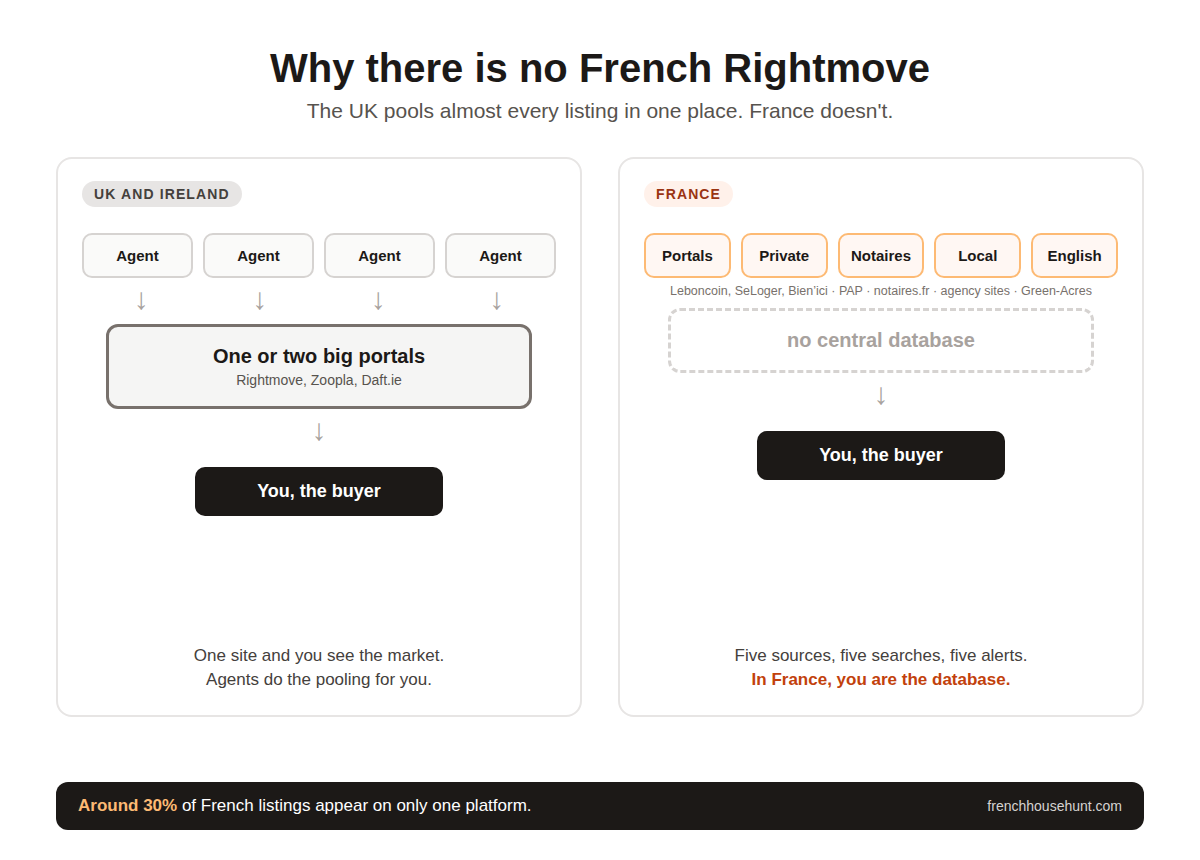
The five layers of the French market
Don’t think in websites, think in layers. Each layer has a different kind of seller, and so a different kind of opportunity.
1. The big commercial portals.
- Leboncoin has the most volume: over a million listings and around 42 million visits a month, private sellers and agents mixed.
- SeLoger is the agents’ stronghold, and has taken private listings too since 2023.
- Bien’ici is owned by the French estate agents’ federations, so it only carries professional listings, but it has by far the best map view.
2. Private sellers. PAP.fr stands for de particulier à particulier and only accepts private sellers. No agency fee, so at the same asking price you pay less. Few foreign buyers search here seriously, because it is all in French and the owner answers the phone.
3. The notaires. immobilier.notaires.fr and immonot.com are the sites of the French notaries. In large parts of the country, especially Normandy, Brittany and the north, the notaire sells houses directly. Those listings often appear nowhere else, and competition from other buyers is lowest.
4. Local channels. The village agency’s own website, the regional paper, the noticeboard at the bakery. Agents usually put a new house on their own site first and only days later on the portals, if at all. This is the layer where speed lives.
5. English-language sites. Green-Acres, Properstar and the UK portals for overseas property. Comfortable, because everything is in English and someone picks up the phone. But it is a selection of a selection, often priced with a foreign buyer in mind. Here, comfort costs money.
Your own French Rightmove, in one evening
The answer is not finding one better website. It is building a system that searches the five layers for you while you get on with your life.
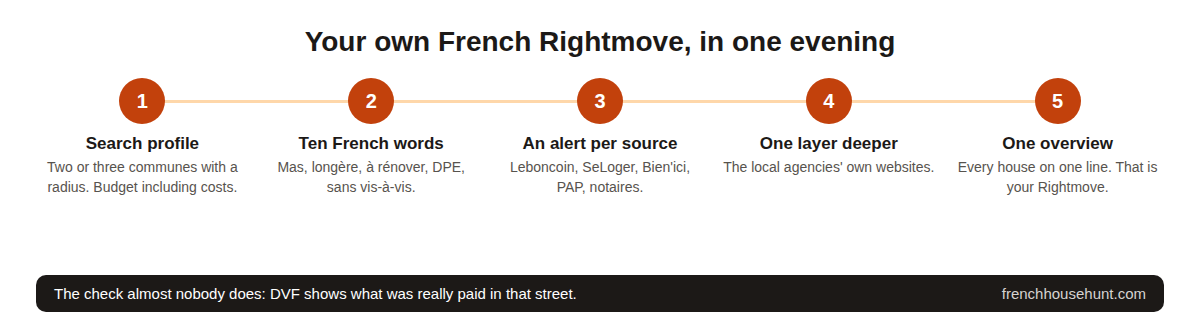
Step 1. Fix your search profile before you open a single site.
- Not “the south of France”, but two or three communes with a radius around them.
- Not “about two hundred thousand”, but a maximum including notaire fees, agency fees and the first round of work.
- Not sure where? Try the region finder first and run your numbers in the buying costs calculator.
Step 2. Learn ten French words. Maison de village, mas, longère, mazet, corps de ferme, terrain constructible, à rénover, viager, DPE, sans vis-à-vis. Without them you search France like a tourist.
Step 3. Save a search with an alert on every source. This is the heart of it, and the step most people skip.
- Create an account on Leboncoin, SeLoger, Bien’ici, PAP and immobilier.notaires.fr.
- Enter your profile, save the search and set the alert to daily or instant.
- Search by commune with a radius, not by département, or your inbox drowns.
From then on the market comes to you. In a popular commune a keenly priced house is gone within a week, and the difference between viewing it or not is exactly that alert.
Step 4. Go one layer deeper than the portals. Search for immobilier plus the town name and open the agencies’ own sites. Bookmark them in a folder and check them every week. Search the same commune on immonot too, because notaire listings rarely reach the portals.
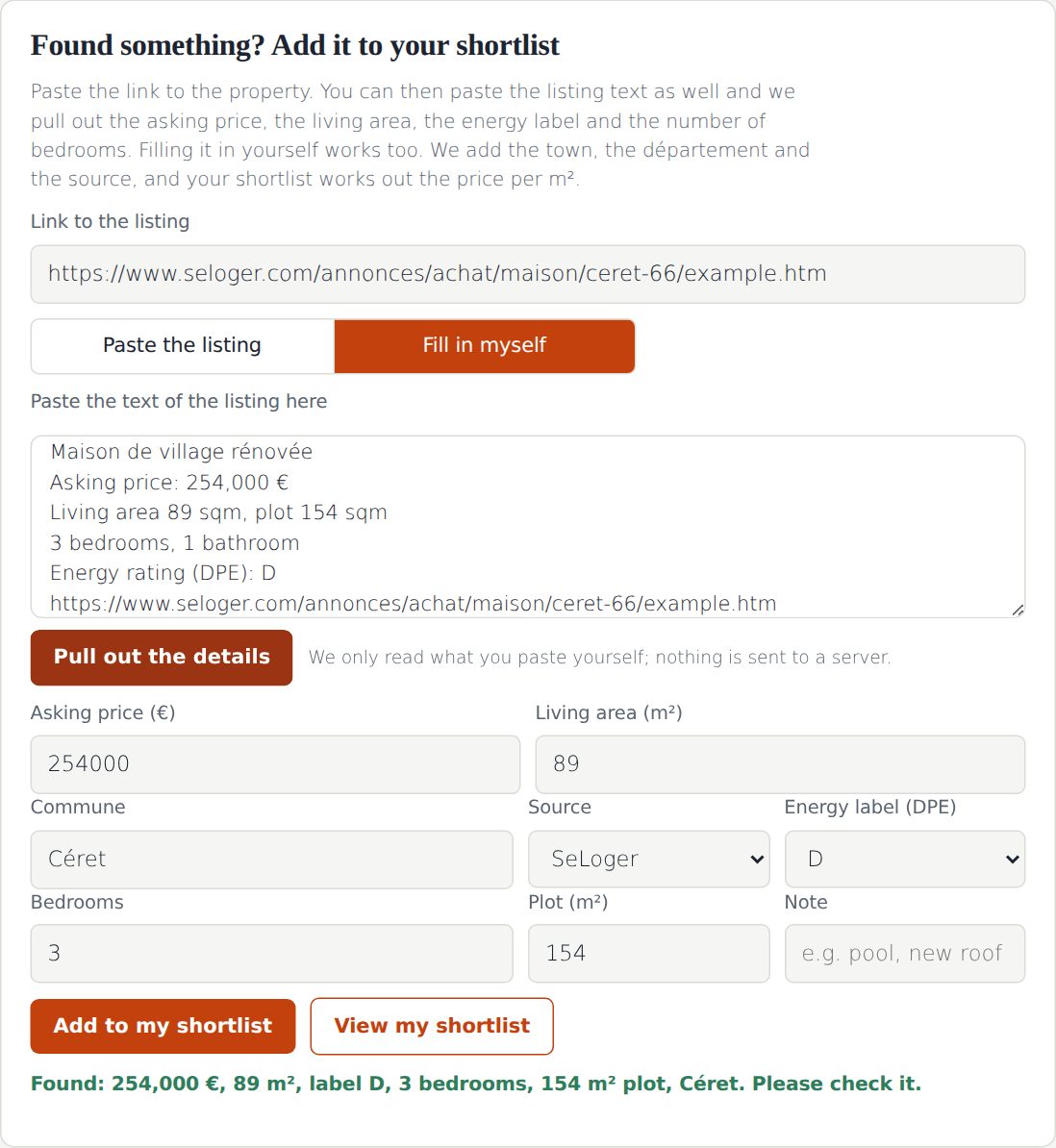
Step 5. Keep everything in one overview. One line per house, with: link, commune, asking price, agency fee included yes or no, living area, plot, DPE rating, taxe foncière, date found, status and your own note.
That overview is your Rightmove. After three weeks it shows you things no site does: which houses stay unsold, where prices drop, and what a realistic price per square metre is in your commune. Take your viewing checklist once you start viewing, and you compare like with like.
Don’t want to build a spreadsheet? The free Shortlist does it for you, with the price per m² worked out. And if the French sites themselves are the problem, the Search Helper sets up steps 1 to 3 on six sites at once.
The check almost nobody does
There is one source no agent will mention unprompted, and you can learn it in five minutes: DVF.
- What it is: demandes de valeurs foncières, the French tax authority’s open database of the prices actually paid in every property sale.
- How far back: the last five years, down to the individual plot.
- How current: updated twice a year, in spring and autumn.
- What’s missing: Alsace, Moselle and Mayotte, where the records are kept elsewhere.
Click on the street where the house is and you see what the neighbours really paid, when, and for how many square metres. Go there before you make an offer, not after. An asking price is an opinion. DVF is a fact.
What this gets you
One evening’s work. Five accounts, five alerts, a bookmark folder of agency sites and the overview from step 5. After that you see more houses than someone who spends an hour on one site every Sunday, and you see them sooner.
The French Rightmove is not coming. Whoever accepts that first sees the house first.
One thing worth knowing before you ring the first agency: the agent works for the seller, not for you, and his commission is usually already inside the asking price.
Sources: listing and visitor figures from Pretto, “Quel est le meilleur site immobilier en 2026”; the 30 percent single-platform estimate and Bien’ici ownership from monmarcheimmobilier.fr (2026); 958,000 sales from the Notaires de France market note of 27 April 2026; DVF details from the app.dvf.etalab.gouv.fr FAQ.