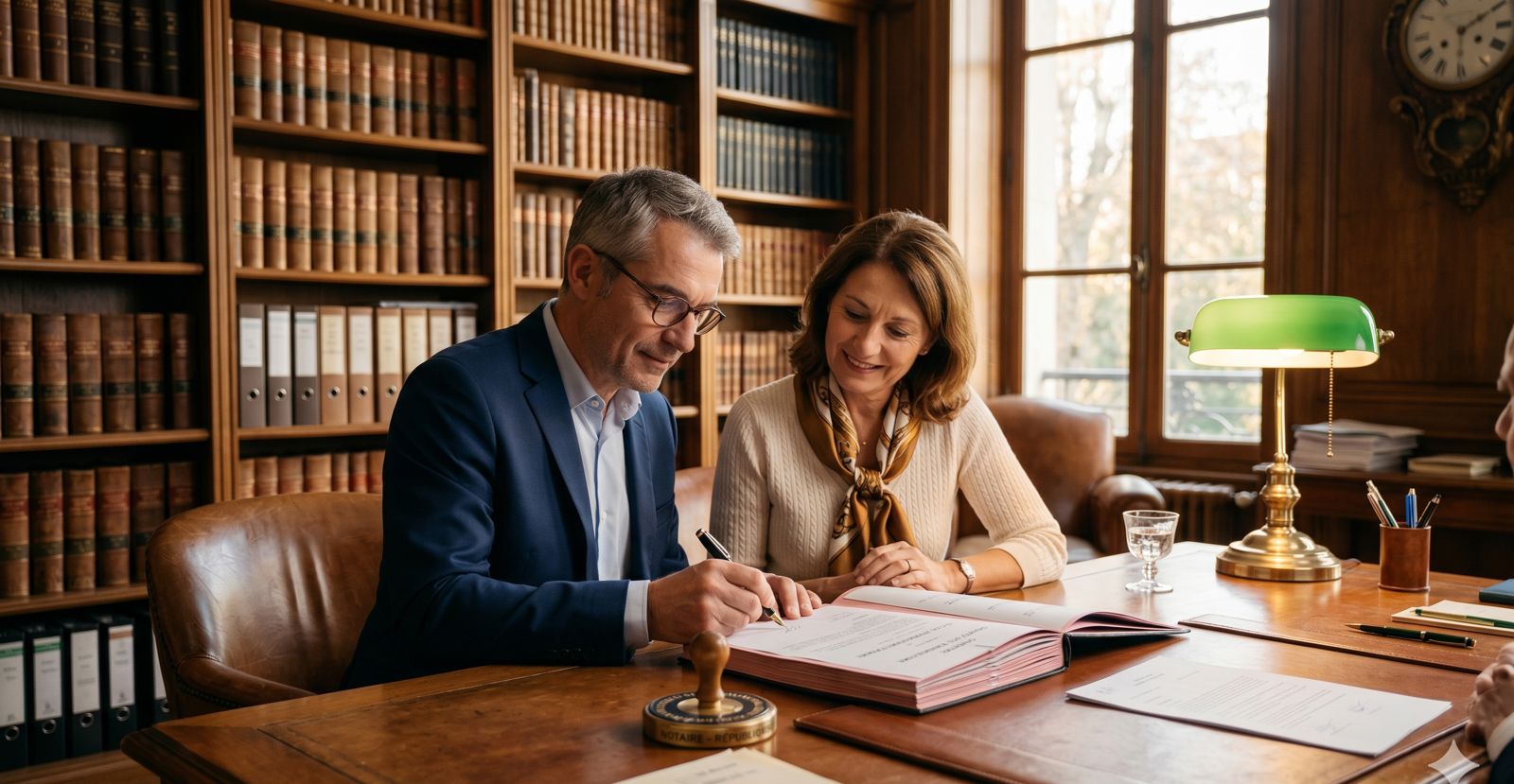
From the first search to collecting the keys at the notaire’s office. Everything we wish we had known when we bought our own house in the Pyrénées-Orientales, written for buyers from the UK and Ireland.
Get the guide as a PDFSee the free tools
In this guide
1. The French rhythm of life: why you want this
The feeling you are looking for exists. Not a fortnight’s holiday, but a way of living.
Picture it: coffee on the terrace in February, in the sun. The bakery a short walk away, the smell of fresh bread as you step outside. Lunch outdoors, still in October, under a hard blue sky. At the weekend you drive into the mountains or nip across the border into Spain. And when evening falls it is quiet. Properly quiet, the kind you hardly find anywhere at home any more.
That rhythm is real, and plenty of people from the UK and Ireland have found it, in the Pyrenees, the Dordogne or the Languedoc. Some buy a second home to spend as much time there as they can; others move for good. Whatever your plan, buying a house in France calls for a clear head. This guide gives you honest, practical information about the buying process, from our own experience.
2. What does a house in France really cost?
The French system works differently from the UK and Irish ones. The extra costs are higher, but they are transparent and easy to work out in advance.
- Budget 7 to 10 percent on top of the price for notaire fees and transfer taxes on an existing house.
- The rates are set by law, so there is nothing to negotiate there.
- Example: a house at €250,000 needs roughly €270,000 to €275,000 in cash or financing.
| Cost | Typical amount | What it is |
|---|---|---|
| Notaire fees (frais de notaire) | 7% to 8% | Mostly transfer taxes, plus the notaire’s regulated fee. For a new build 2 to 3 percent. |
| Estate agency fee | 3% to 6% | Usually already included in the asking price (FAI: frais d’agence inclus). |
| Diagnostics | paid by the seller | The compulsory survey pack. The seller orders it and hands it over. What is in it. |
| Building survey | €400 to €600 | Your own choice, strongly recommended for older houses. The French pack is not a structural survey. |
| Legal or language help | €500 to €1,500 | Useful for a first purchase or if your French is not strong. |
| Buildings insurance | €300 to €800 a year | Required from the day you get the keys. |

Mind the exchange rate
You pay in euros. If your money is in pounds, a small move in the exchange rate between offer and completion can change the sterling cost of the house by thousands of pounds.
- Know your number in euros and check today’s GBP rate before you make an offer.
- Compare providers. Many buyers use a currency transfer specialist authorised by the FCA rather than a high-street bank, and some fix a rate in advance with a forward contract.
- Borrowing in euros takes the currency risk out of the loan, but not out of repayments made from a sterling income.
Work it out exactly. In the free buying costs calculator you enter the asking price and immediately see the total you need, including notaire fees, agency fees and an optional mortgage.
Take the cost table with you
This table, and the whole guide, is in the PDF version. Handy to print, or to have on your phone when the conversation turns to money.
We email you the guide. Unsubscribe at any time.
3. The buying process in seven steps
Buying in France works differently from home, but it is easy to follow. From first viewing to keys, allow three to four months.
- Set your budget. Start with a clear view of what you can spend, including all the extra costs. If you do that sum first, you search in a more focused way and negotiate from a stronger position.
- Choose your region deliberately. The Pyrénées-Orientales, the Dordogne, the Languedoc, Brittany: each has its own feel, climate, price level and community. Spend at least a full week there outside the high season. Not sure yet? Try the region finder.
- Work with a good agent. A reliable agent immobilier knows the local market inside out. Ask to see the carte professionnelle (the agent’s licence), and check membership of a body such as FNAIM or SNPI and experience with foreign buyers.
- Assess the condition of the house. For every sale the seller must provide a dossier de diagnostic technique: reports on energy performance, asbestos, lead, electrics and more. Read it yourself and have a builder or surveyor look at an older house.
- Sign the compromis de vente. This is the preliminary contract, and from then on both sides are committed. As a private buyer you get a legal 10-day cooling-off period after signing, no reason needed. Use it to reread everything calmly; after that the agreement is binding. A deposit of around 10 percent is usual.
- Arrange your finance. Many buyers from the UK and Ireland pay from savings or equity at home. If you want a French mortgage, expect to put down 15 to 30 percent and to provide a thick file of paperwork. French lending rules cap repayments at 35 percent of income and the term at 25 years, and they apply to non-residents too. Make sure the finance is in place, or protected by a loan condition in the compromis, before you sign.
- The acte authentique and the keys. The final transfer happens at the notaire’s office, usually two to three months after the compromis. The notaire reads through the whole deed, which can easily take more than an hour. Bring an interpreter if your French is not strong; that is always allowed. After signing you get the keys.
Source for the cooling-off period and deposit: service-public.gouv.fr. Lending rules: HCSF (economie.gouv.fr).
4. Notaires, law and tax
If you understand how the French system works, you buy with less risk and avoid surprises later.
The notaire is not your solicitor
A French notaire is a public official who oversees the transaction as a neutral party. He or she does not act for you, nor for the seller. You are always entitled to appoint your own notaire alongside the seller’s, and on a first purchase that is well worth doing.
It costs you nothing extra: the two notaires share the regulated fee. What you do get is someone who reads the contracts from your point of view and answers your questions in plain language. Some UK buyers also use an English-speaking lawyer who specialises in French property.
Yearly taxes as an owner
- Taxe foncière: the local property tax every owner pays. It varies hugely by commune and type of house, from a few hundred to several thousand euros a year. Always ask for the latest bill; the seller has it.
- Taxe d’habitation: abolished for main homes, but still charged on second homes.
- Letting: if you let the house, extra rules apply and you declare the income in France. Take advice from a local expert-comptable first.
- At home: you may also have tax obligations in the UK or Ireland. The UK and France have a double taxation agreement; a cross-border tax adviser can tell you how it applies to you.
5. The five mistakes we see most
From our own experience and from the stories of many other buyers. All of them avoidable.
A charming stone house can hide defects that cost tens of thousands of euros: a leaking roof, old wiring, damp walls. Have an independent expert look at it before you sign the compromis.
The notaire guards the process, not your interests. Appoint your own; it costs nothing extra.
Always add 10 percent to the price, plus a buffer for the first year of maintenance and for exchange-rate moves. Otherwise you get squeezed right after completion.
A classic sales tactic. You have 10 days to change your mind after the compromis. Use them.
A village you have only seen in July is a village you don’t know. What is it like in November? Are there neighbours, is there a shop? Go at least twice, in different seasons.
6. Which region suits you?
France is big and varied. The right region depends on what matters to you: climate, how you travel from home, and budget.
| Region | Feel and character | Strong point | From the UK and Ireland |
|---|---|---|---|
| Pyrénées-Orientales | Sun, sea, mountains and Spain next door. Truly Mediterranean. | Around 300 sunny days a year; much cheaper than Provence. | Seasonal flights to Perpignan; Girona and Barcelona all year. |
| Dordogne / Périgord | Rolling green hills, châteaux, markets and calm. | A lot of house for your money, especially character properties. | Bergerac in summer; Bordeaux all year. |
| Languedoc | Warm, spacious and authentically French. Vineyards everywhere. | Keen prices combined with plenty of sun. | Carcassonne, Béziers, Montpellier, Toulouse. |
| Provence / Côte d’Azur | Stylish, lavender, history, world famous. | International appeal and strong value retention. | Nice and Marseille, many routes all year. |
| Brittany | Green, rugged, by the sea and proud of its traditions. | Beautiful nature, mild summers, easy to reach. | Ferries to St Malo and Roscoff, including from Cork. |
Our advice: visit at least two regions before you choose and stay a full week, not just a weekend. Go out of season too; a village in November tells you more than a village in July. We chose the Pyrénées-Orientales ourselves and have not regretted it for a day. Flight and ferry routes change every season, so check current timetables.
Not sure where to look? The region finder asks you eight questions and gives you the three regions that suit you best, with travel notes from the UK and Ireland.
7. How to find what is for sale
There is no French Rightmove. Houses for sale are spread across websites, agents, notaires and private sellers, and nobody does the searching for you. With a simple system, though, the listings come to you.
When we started looking seriously, the first thing I did was search for the French equivalent of Rightmove. That evening I learned it doesn’t exist, and that this is not a gap in the market but simply how the French market works. A seller may list with several agents at once, each agent pays to appear on the big portals, and a good share of what is for sale never appears there at all.
The five layers of the French market
| Layer | Where | What you find |
|---|---|---|
| Big portals | Leboncoin, SeLoger, Bien’ici | The bulk of agency listings; none is complete. |
| Private sellers | PAP.fr, Leboncoin | No agency fee, so often cheaper. In French. |
| Notaires | immobilier.notaires.fr, immonot.com | Houses listed nowhere else, especially in the north and west. |
| Local | The agency’s own website, the shop window | New listings often appear here days before the portals. |
| English-language | Green-Acres, Properstar, overseas portals | Comfortable, but a small selection, often priced for foreign buyers. |

More on this: what a French estate agent does, what the commission costs and how to approach an agency.
Your own search system, in one evening
- Fix your search profile: two or three communes with a radius around them, and a maximum price including all extra costs.
- Learn ten French words: maison de village, mas, longère, à rénover, DPE, sans vis-à-vis. Otherwise you search like a tourist.
- Save a search with an alert on each source: Leboncoin, SeLoger, Bien’ici, PAP and immobilier.notaires.fr. By commune, not by département, or your inbox drowns.
- Go one layer deeper: search for immobilier plus the town name and check the local agencies’ websites every week.
- Keep everything in one overview: one line per house with link, asking price, floor area, DPE, date and status. After three weeks you see which houses stay unsold and where prices drop.
The check almost nobody does: the French government’s DVF database shows the prices actually paid in every sale over the past five years, down to the plot. It is updated twice a year and does not cover Alsace, Moselle or Mayotte. Look there before you make an offer. An asking price is an opinion; DVF is a fact.
Can’t face the French sites? The Search Helper sets up your search on six French property sites at once, and the Shortlist keeps track of every house you find, with the price per m². The full story is in There is no French Rightmove.
The plan on paper
The five layers of the French market and the step-by-step plan are in the PDF, so you can keep them next to you while you set up your alerts.
We email you the guide. Unsubscribe at any time.
8. The viewing trip
A well-prepared viewing trip makes all the difference. It lets you judge honestly whether the region, the village and the house fit the way you want to live there, and not just how it looks in summer.
- Budget: fix your maximum in advance, including all extra costs.
- Wish list: write down your must-haves and agree them with your partner before you go.
- Time: plan at least four or five days in a row; French regions are bigger than they look.
- Agents: book viewings in advance through local agents; on the spot it often doesn’t work.
- The village: see it on an ordinary weekday too, for an honest picture.
- Amenities: check the distance to the GP, supermarket, station and airport.
- Notes: write down your impressions straight after each viewing, or the houses blur together.
Five questions to ask at every viewing
| Question | Why |
|---|---|
| How long has it been on the market? | More than six months almost always means room to negotiate. |
| Is the agency fee included (FAI)? | It can easily make 5 percent difference to the price you had in mind. |
| What is the taxe foncière? | The seller has the bill. Ask; it varies a lot from village to village. |
| What is the DPE rating? | With F or G, letting is restricted and improving the house is a big cost. |
| Is anything planned nearby (PLU)? | You don’t want a building site or wind farm in your view in two years’ time. |
Take the checklist. The online viewing checklist walks you through 25 points and works fine on your phone.
The PDF works without signal
In many French villages your mobile signal drops out. Saved on your phone, the PDF gives you the five questions and the checklist exactly when you need them.
We email you the guide. Unsubscribe at any time.
9. After Brexit: visas, the 90/180 rule and residency
Owning a house in France does not give you the right to stay there as long as you like. Since 1 January 2021 UK citizens are treated as non-EU nationals. Here is what that means in practice, as of September 2026. Rules change, so always check the official sources below before you travel or plan a move.
The 90/180-day rule
- Short stays: as a UK citizen you can spend up to 90 days in any 180-day period in France and the rest of the Schengen area without a visa. Every day in any Schengen country counts.
- Passport: it must have been issued less than 10 years ago and be valid for at least 3 months after the day you plan to leave.
- Overstaying can lead to a ban from the Schengen area.
- Entry/Exit System (EES): since April 2026 your entries and exits are recorded digitally, with fingerprints and a photo, instead of passport stamps. That makes the 90/180 count automatic.
- ETIAS, the EU travel authorisation, is not yet in operation. The EU will announce its start well in advance.
Staying longer as a second-home owner
- 3 to 6 months: you need a temporary long-stay visitor visa (VLS-T).
- More than 6 months: you need a long-stay visa that acts as a residence permit (VLS-TS “visiteur”), and after that a residence card from the préfecture.
- What they ask for: in broad terms, enough income or savings to live without working, health insurance for the whole stay, proof of accommodation and an undertaking not to work in France. Apply from the UK before you go, through France-Visas.
If you already lived in France before 2021
UK nationals who were legally resident in France before 1 January 2021 are covered by the Withdrawal Agreement and hold a special residence card (titre de séjour Accord de retrait). Those cards need renewing online when they expire. RIFT (Remain in France Together), a volunteer association, is a good place to find practical information for this group; it does not give legal advice.
Irish citizens
Irish citizens are EU citizens, so none of the above applies: no visa, no 90/180 rule, no EES. To live in France for more than three months without working, EU law expects you to have sufficient resources and health insurance.
Official sources and support
- gov.uk: France entry requirements
- gov.uk: Living in France (visas, healthcare, driving licences, tax)
- France-Visas: UK nationals after Brexit
- British in Europe, the coalition of UK citizens’ groups in the EU
- RIFT, Remain in France Together
- Your Europe: residence rights for EU citizens
This chapter is general information, not immigration advice. For your own situation, check with the French consulate or an immigration specialist.
10. Your next steps
Buying a house in France starts with knowledge, and knowledge starts with asking questions. Three things you can do today:
- Run your numbers. Use the buying costs calculator and know within two minutes what you really need.
- Set up your search. Let the Search Helper prepare your search on six sites and start your Shortlist.
- Plan your stays. Check how the 90/180 rule fits the way you want to use the house, before you fall for one.
And remember: the biggest risk is waiting too long while the dream is within reach.
Want the guide as a PDF?
The same guide as a neatly designed PDF, to print or take on your viewing trip. It lands in your inbox straight away.
We email you the guide. Unsubscribe at any time, and we send you nothing else unless you ask for it.
All free tools
This guide is general information and does not replace personal legal, tax, immigration or financial advice. For your own situation, always consult a notaire, tax adviser or other qualified professional.