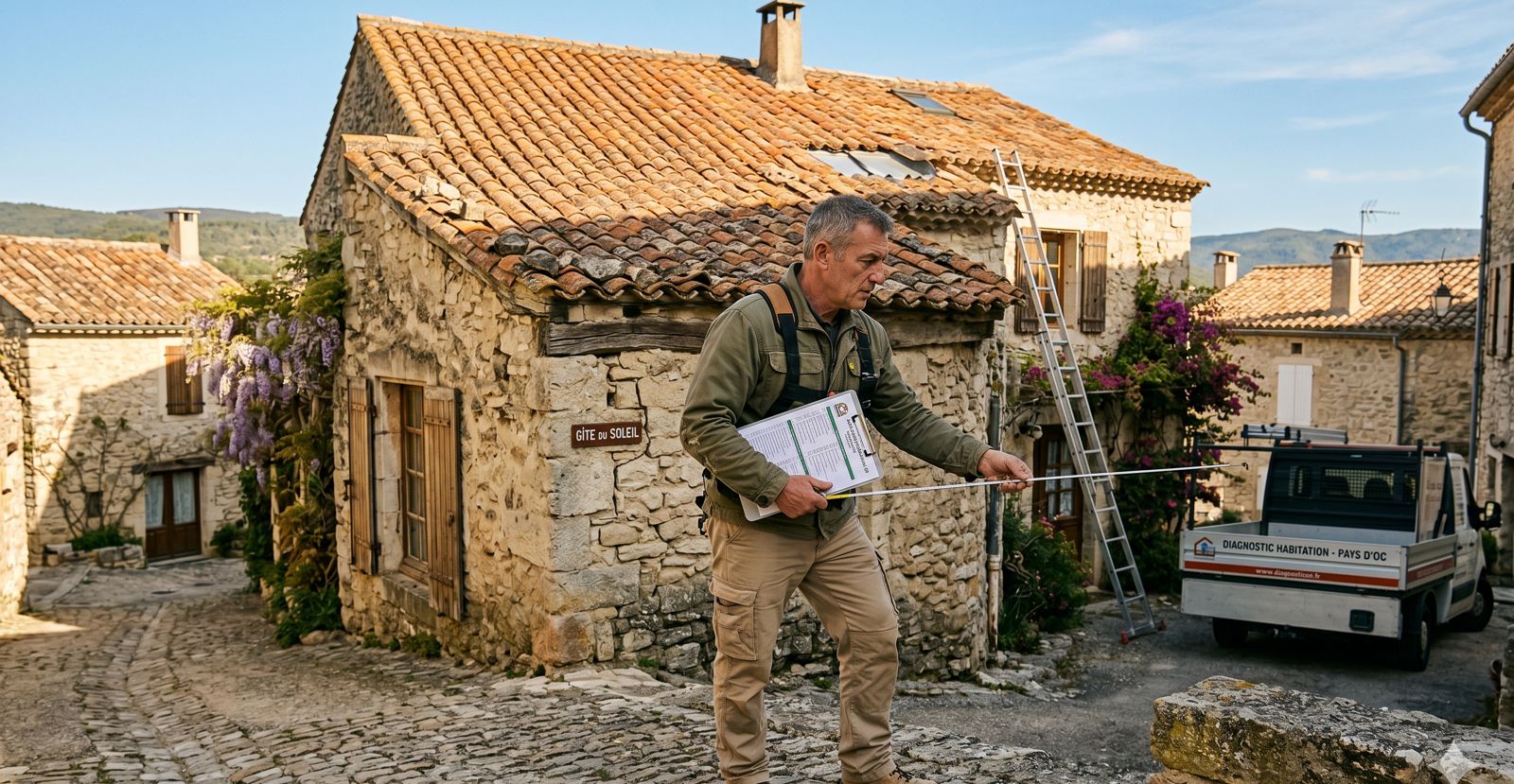
When we bought our house in Sainte-Marie-la-Mer, we were handed a stack of more than sixty pages of French: the dossier de diagnostic technique. We leafed through it that evening, saw the letter of the energy rating and more or less skipped the rest. Looking back, two things in there were worth knowing before we signed. So here it is: report by report, what it is, what to look for, and when to ask more questions.
Already have the pack? Get it out and we will go through it together. Don’t have it yet? The seller must give it to you before you sign the compromis, so ask for it.
First: there is no British-style survey in France
If you have bought in the UK or Ireland, you probably expect a surveyor’s report on the condition of the house. France doesn’t work like that.
- What the pack is: a set of compulsory reports by a certified diagnostiqueur, ordered and paid for by the seller. It records specific legal points: energy, asbestos, lead, termites, electrics, gas, drainage, natural risks.
- What it is not: a structural or building survey. Nobody checks whether the roof is sound, whether there are cracks in the foundations or whether the boiler will last another ten years.
- Want that checked? Commission it yourself: a French expert en bâtiment or an English-speaking surveyor working in France. It is unusual there, but nothing stops you, and for an old house or a big budget it is money well spent.
- Independent: the diagnostiqueur is neither the agent nor the notaire.
The reports at a glance
Not every house gets every report. Which ones are required depends on the age of the house, its location and its installations.
| Report | When required | Valid for |
|---|---|---|
| DPE, energy rating | Almost every home | 10 years (but see below) |
| Energy audit | Houses rated E, F or G | 5 years |
| Lead (CREP) | Built before 1949 | Unlimited if no lead found |
| Asbestos | Building permit before July 1997 | Unlimited if none found |
| Termites | In a designated termite zone | 6 months |
| Electricity | Installation over 15 years old | 3 years |
| Gas | Installation over 15 years old | 3 years |
| Septic tank (SPANC) | Not on mains drainage | 3 years |
| Risks (ERP) | Commune in a risk zone | 6 months |
| Carrez floor area | Flats and houses in copropriété | Unless works are done |
Sources: service-public.gouv.fr and ecologie.gouv.fr, checked September 2026.
DPE: the energy rating
The diagnostic de performance énergétique rates the house from A (very efficient) to G. It gives two figures: energy use in kWh per m² per year, and CO2 emissions. Since 2021 it is legally binding.
Why it is the most important report
- Letting ban. G-rated homes can no longer be let on a new lease since 2025; F follows in 2028 and E in 2034. Buying to let? Then an E, F or G is a renovation budget, not a detail. A bill to soften how the ban is enforced is going through the French parliament in autumn 2026; it is not law yet.
- Room to negotiate. An F or G is an accepted argument for talking about the price, and agents know it.
- Energy audit. For a house rated E, F or G the seller must also provide an audit énergétique with renovation scenarios and cost estimates. That is a gift: someone has already drafted your renovation budget.
What to check
- The date. Any DPE made before 1 July 2021 is no longer valid.
- Electric heating? The calculation changed on 1 January 2026 in favour of electricity, and changes again on 1 January 2027. Many electrically heated homes now score better, and the owner can download an updated certificate free of charge from the ADEME observatory. Ask the seller whether that has been done.
- Holiday homes. The DPE assumes someone lives there all year. A summer house rated F that you only use in July and August costs you far less to heat than the rating suggests.
Asbestos and lead
- Asbestos (amiante): the report says whether asbestos was found and where: roof sheets, floor coverings, pipe lagging. Asbestos left in place in good condition is not a problem; asbestos you need to remove for a renovation is a real cost. Check whether it sits in anything you want to change.
- Lead (plomb, CREP): measures lead paint in houses built before 1949. Class 3 means flaking lead paint, a health risk for children. Classes 1 and 2 can be painted over; class 3 needs removing.
Termites, electrics and gas
- Termites: large parts of southern and western France are termite zones, the Pyrénées-Orientales included. The report is only valid for six months, so a long purchase may need a new one. Signs of termites are not necessarily a disaster, but you want to know where and whether they are active.
- Electricity and gas: two separate reports on safety, not capacity. A 1970s installation can pass and still be far too light for an induction hob plus air conditioning plus a car charger. Count the anomalies, and ask what the supply is (puissance souscrite, on the electricity bill): 6 kVA is tight for a family, 9 or 12 is comfortable.
Drainage: the report we should have read
On mains drainage (tout-à-l’égout) there is usually little to see. With a private septic tank (assainissement non collectif) an inspection by the SPANC, the local drainage authority, is required, less than three years old.
- Look for “non conforme”. If it says so, you as the buyer must bring the system up to standard within one year of buying.
- The cost: a new septic tank or micro treatment plant easily runs into five figures. It is the biggest hidden cost in the whole pack.
- Use it: it is also a strong negotiating point, because the seller knows it too. Get a quote before you make your offer.
ERP: natural and other risks
The état des risques is a printout of official maps, not an inspection: flood zones, earthquake zone, wildfire risk, soil pollution, radon, shrink-swell clay. Valid for six months.
- Flooding affects your insurance premium, and whether you can get cover at all.
- Shrink-swell clay can explain the cracks you noticed at the viewing.
- Wildfire zone means compulsory clearing of undergrowth around the house (débroussaillement).
- Check any address yourself on georisques.gouv.fr.
Read the pack in ten minutes
- Dates: is the DPE from after July 2021, and are the termite and risk reports less than six months old?
- DPE letter: E, F or G? Find the energy audit and read the cost estimate.
- Drainage: conforme or non conforme? If not, get a quote and factor it into your offer.
- Electrics: serious anomalies? Get a quote before the compromis.
- Asbestos and lead: only a problem where you plan to renovate.
- Risks: flooding, clay, wildfire. Call your insurer.
What if something is wrong?
- A report is missing or out of date: the notaire cannot complete the sale without a valid pack. Ask the seller for a new report; that is their responsibility.
- You find something serious after the compromis: within the 10-day cooling-off period you can withdraw at no cost. After that only through the conditions in the contract, or a defect the seller knowingly hid (vice caché).
- You want certainty: get your own building survey before the compromis.
Tools for this page: the buying costs calculator for adding renovation costs from the audit, the viewing checklist with the questions on heating, drainage and electrics, and the Search Helper, which reads the DPE letter from a pasted listing.
Want the complete buying guide?
The step-by-step plan for buying a house in France, as a PDF in your inbox.
We email you the guide. Unsubscribe at any time.
More free tools
General information, checked against official French sources in September 2026. Rules change regularly; your notaire and diagnostiqueur have the final word.